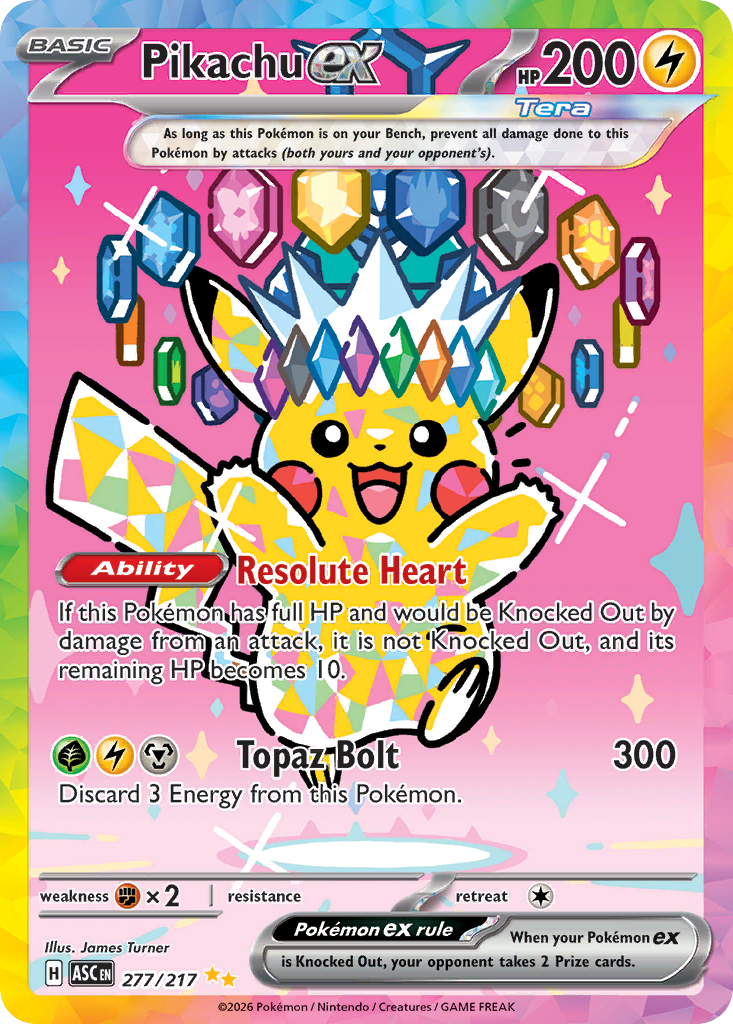
On August 24, 2026, James Turner announced that he had joined The Pokemon Company International as Creative Director of Pokemon Art and Design. He is the first Westerner to officially design a Pokemon, and he has illustrated only a handful of trading cards in his life. The most prominent one is sitting in Ascended Heroes right now: Pikachu ex, card 277 of 217, a Pikachu built out of cut gemstones.
The art
A special illustration rare is the top art tier a modern set prints. The illustration runs to all four edges, the game text is squeezed into the lower third, and the illustrator gets the whole card to work with. Most of them are paintings. This one is not.
Turner draws flat. Thick black outlines, clean shapes, no brushwork anywhere, closer to a poster or a game icon than to an oil study. Pikachu sits front and center with its arms up and its mouth open in a full open grin, and the yellow of its body is broken into small pastel facets in mint, sky blue, rose and lemon, as if light is passing through it rather than landing on it. The tail is the clearest example. Instead of a solid yellow bolt it is a faceted crystal wedge, cut into flat panels of cream and pale green, outlined heavily enough to read as a shape from across a room.
On its head is a crown. A ring of white and ice blue crystal spikes rises off the brow, and under it runs a row of small faceted stones in violet, grey, blue, green and orange. Behind all that, fanned out across the top of the card like a display case tipped over, are a dozen large cut gems drawn as flat icons: a rose one, a steel grey one, sapphire blue, emerald green, amethyst, amber, and a big yellow topaz sitting dead center above Pikachu's ears. The background is hot pink, scattered with pastel diamonds and clean white sparkle crosses.
None of that is decoration for its own sake. This is a Terastallized Pikachu with the Stellar Tera Type, and its attack is called Topaz Bolt, named after the gemstone that historically lent its name to any yellow stone. Turner took the card's own mechanic literally and drew the Pokemon as the mineral. The result is the rare special illustration rare you can identify at thumbnail size, which is exactly what a designer, rather than a painter, tends to give you.
He has almost no other cards. His first was a Pansear common in Next Destinies back in 2012. Then nothing until 2024, when he drew the Duskull, Dusclops and Dusknoir illustration rares in Shrouded Fable. This Pikachu is the fourth act in a fourteen year run of five cards. Worth noting that Ascended Heroes prints a second Pikachu ex special illustration rare two numbers earlier at 276, illustrated by booota, and it is a completely different card with a completely different Pikachu. If you go hunting for this one, the number matters.
Why it is trending
The catalyst has a date on it. Turner posted the announcement on August 24, and the coverage followed the next morning. He had been away from the franchise for four years, having left Game Freak on June 9, 2022 to start his own studio, All Possible Futures, which released The Plucky Squire in 2024. Before that he was Art Director on Pokemon Sword and Shield, and he designed a long list of Pokemon that people are suddenly relisting everywhere: the Vanillite line, Golett and Golurk, Vullaby and Mandibuzz, Phantump and Trevenant, Buzzwole, Guzzlord, Poipole and Naganadel, Sinistea and Polteageist, Obstagoon, Bruxish, Dondozo. He also designed Gigantamax Pikachu. So when collectors went looking for what he had actually drawn on cardboard, the search landed on a very short list, and this card is the top of it.
The timing helps. 30th Celebration releases worldwide on September 16, and every booster pack in that set contains one of thirty different Pikachu cards, each under a glimmering fireworks foil layer. The hobby's entire art conversation right now is Pikachu. Turner's card is the Pikachu you can already buy.
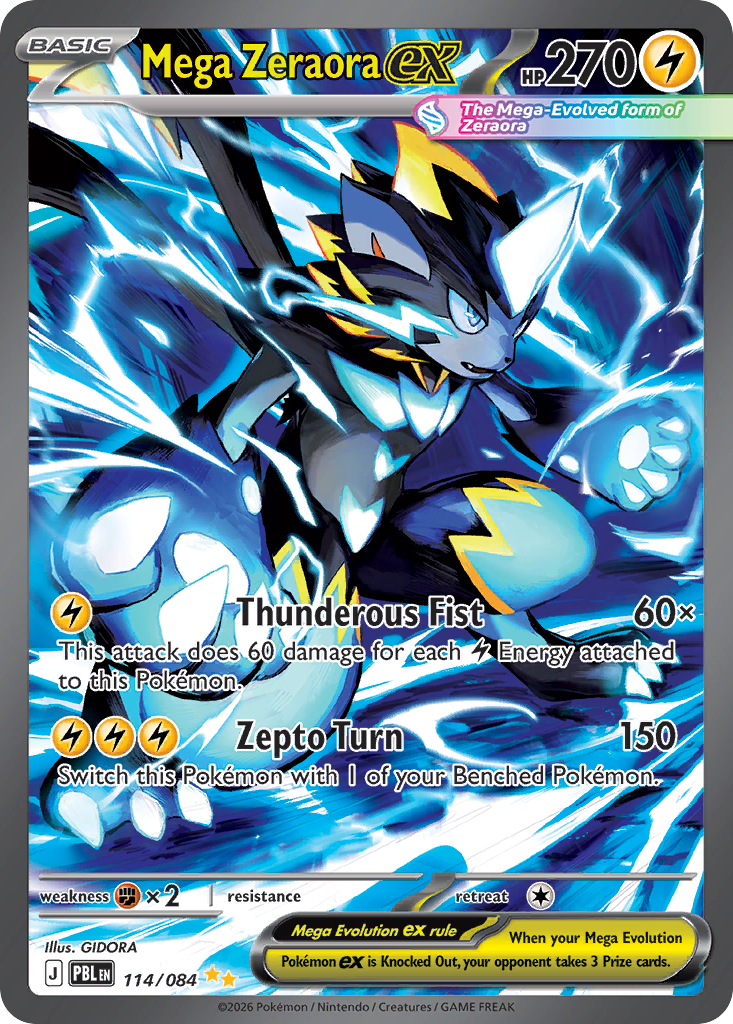
Be honest about what this is. Nothing about the card changed on August 24. The print run is the same, the pull rate is the same, and the same Pikachu ex had already received a special illustration rare in Surging Sparks, illustrated by GIDORA, who also drew the Mega Zeraora ex in Pitch Black. What changed is the story attached to the credit line, and story is a real driver in card art even when the supply is not moving. Buy this one because you like looking at it, not because you think a job announcement is a scarcity event.
Build a binder page around it
This card is a color sorting problem in the best way. It is not one color, it is a hot pink field with a full spectrum of gems laid across the top, which means it will fight almost anything you put beside it and win. Do not bury it in a page of yellow Electric types. It will make them look dull.
Instead, use it as an anchor. Open the builder, run color sort, and build a nine pocket page as a rainbow arc with this card in the center pocket. The gems along the top edge already run through blue, pink, grey, green and amber, so the card acts as a summary of the page around it, and every neighbor picks up one of the stones. That is a far better use of the rainbow feature than a strict left to right spectrum, which tends to look tidy and read as flat.
The other idea is a designer page. Put Turner's Pikachu next to cards that show Pokemon he actually designed, so the page tells you something rather than just matching colors. A Golurk, a Trevenant, a Polteageist, an Obstagoon, and the Duskull line illustration rares he drew himself in Shrouded Fable. That gives you a page nobody else in your playgroup has built, and it survives the day you get bored of sorting by color. If you want the pairing that goes furthest, put it opposite a card by Atsuko Nishida, who designed Pikachu in the first place. One page, both ends of the character's history.
One practical note. The pink background runs right to the corners, so edge wear shows fast on this card. Decide where it lives before it goes into a pocket, which is the whole argument of our guide to organizing a Pokemon binder, and then leave it alone.
The takeaway is that a credit line is worth reading. Most collectors sort by Pokemon, set or price, and never once look at the four words in the bottom left corner of the card. Those four words are how you find out that the person now steering Pokemon art direction has drawn exactly five cards, and that one of them is a Pikachu made of topaz sitting in a set you probably already own packs of. Flip your binder over and read the small print. It is the cheapest way to make a page mean something.