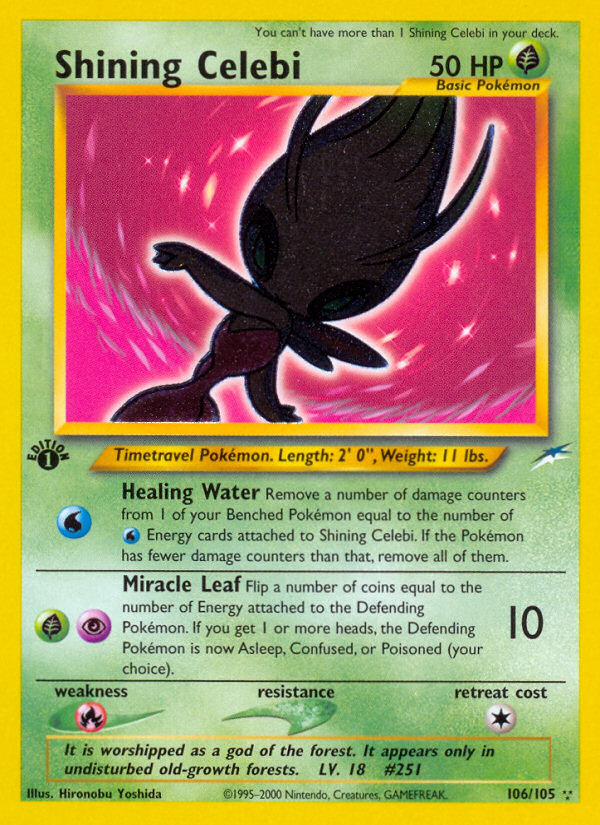
Shining Celebi is card 106 in a set of 105, which tells you before you read anything else that it was not meant to be easy to find. It came out in Neo Destiny in February 2002, it was drawn by the Game Freak designer who created Celebi in the first place, and it does one thing that no rarity printed since has bothered to copy. The holo foil is not in the background. It is on the Pokemon. Today the card comes back in 30th Celebration.
The art
Start with what is missing. There is no forest, no shrine, no time travel imagery, nothing a modern illustration rare would give you. Hironobu Yoshida paints a single flat field of hot magenta that spirals counter clockwise out from behind Celebi, described with nothing but pale pink streak lines and a scatter of four point sparkles in white and warm yellow. That is the entire setting. A colour and a swirl.
Celebi sits in the middle of it turned three quarters away from you, and it is almost entirely black. The head and the trailing head fringe hold a faint green sheen at the top edge, the lower body and the legs carry a dark maroon wash, and the only clear colour anywhere on the animal is a pair of small dark green eyes with one pale glint each. A soft white halo traces the whole outline and keeps the black body from dissolving into the pink. The pose is turned inward, one arm raised, wings folded back, reading as something caught mid hover rather than posed for you.
Now look at where the foil goes. On a normal holo card the shimmer lives in the illustration window behind the Pokemon, which is why every Base Set holo has that mirrored background and a flatly printed animal on top of it. Shining Celebi inverts that. The reflective treatment sits on Celebi's body, so the black fills with fine glitter while the magenta stays matte. Bulbapedia records this as the defining trait of the Neo era Shining subset, a foil treatment applied to the Pokemon itself to make it literally shine, and it is the reason the card cannot be photographed properly. The part that moves is the part your eye is already locked onto.
The comparison that makes it land is sitting five months earlier in the same artist's catalogue. Yoshida drew the regular Celebi as card 3 of Neo Revelation in September 2001: a pale yellow green Celebi, one big open eye with a violet iris, floating over a black hill against a deep blue starfield with holo snowflakes scattered through the background. Put the two side by side and it is the same Pokemon by the same hand with every value reversed. Light body on dark ground becomes dark body on light ground. Background foil becomes body foil. Facing you becomes facing away.
Yoshida is not a career card illustrator. He is a graphic designer who has worked on the core games since Pokemon Yellow in 1997, he has designed the main World Championships art since 2007, and the Pokemon he is credited with designing include Wobbuffet, Dunsparce, Rayquaza, Deoxys, Darkrai and Celebi itself. He has only around thirty nine cards to his name, and five of the eight Neo Destiny Shinings are his, including Charizard, Mewtwo, Kabutops and Raichu. Ken Sugimori drew the other three. Being handed the Shiny version of a Pokemon you designed yourself is about as close to an author's cut as this hobby gets.
Why it is trending
The catalyst has a date on it. 30th Celebration releases on September 16, 2026, and alongside the new cards it carries a Classic Collection of reprints pulled from thirty years of the game. Shining Celebi is on that list, reissued with a Pokemon 30th Anniversary stamp and a special textured foil treatment, and it keeps its original English numbering of 106 out of 105 rather than taking a new one. The Japanese print sits at 141 of 103.
There is precedent for exactly this move. Celebrations did the same thing for the 25th anniversary in 2021, reaching back into Neo Revelation for Shining Magikarp and giving it a stamp and a new foil. That card is the reason the Shining subset stayed in circulation at all for a younger audience, and it is the same instinct that made the Magikarp illustration rare beat rarity on art alone a couple of years later.
Be honest about the money, because it changes what you should actually buy. PriceCharting on September 16, 2026 has the 2002 original at 401 dollars ungraded, 1,422.63 in grade 9 and 4,476.53 in a PSA 10. That is not a binder card for most people. It is a safe card. The reprint is the version that goes in a sleeve, and anyone quoting you a firm price for it today is guessing, because day one numbers on a set that released this morning are noise rather than a market. Wait a few weeks and look at sold listings, not asks.
What the reprint does not do is change the original. Neo Destiny printed what it printed in 2002 and no anniversary stamp unprints it. What it does do is put a twenty four year old art idea back in front of people who have only ever opened modern packs.
Build a binder page around it
This is the part that makes Shining Celebi worth a page rather than a slot. The Neo Destiny Shinings were not a random group. There is exactly one per energy type, and Water is deliberately missing because Neo Revelation had already used it on Gyarados and Magikarp the previous autumn.
So the page is a type wheel, not a set. Celebi is Grass at 106, then Charizard Fire 107, Kabutops Fighting 108, Mewtwo Psychic 109, Noctowl Colorless 110, Raichu Lightning 111, Steelix Metal 112 and Tyranitar Darkness 113. Eight cards in numerical order is also eight cards in type order, which almost never happens. Drop them into a nine pocket page in that sequence and put a Water Shining in the ninth pocket to close the wheel. The page is then defined by a rule rather than by a checklist, and the empty pocket has an obvious right answer instead of being a gap.
Colour sorting is where people usually go wrong with these. Every Shining Pokemon is deliberately the wrong colour, so a strict spectrum arrangement reads the recolour instead of the Pokemon and the page turns to mush. Use the tool the other way round. Open the builder, lay the eight out, and sort on the background field rather than the body, since the backgrounds are the part the illustrators kept honest.
The second page is the pairing page, and Celebi is the best argument for it. One row per Pokemon, normal print on the left, Shining print on the right. For Celebi both halves are Yoshida, Neo Revelation 3 next to Neo Destiny 106, so the row shows you one illustrator making the same call twice in opposite directions. If you want the layout fundamentals before committing an order, our guide to organizing a Pokemon binder covers sorting and page logic, and the nine Amazing Rares page is the closed set version of the same exercise.
The takeaway is that the best pokemon card art is usually the art that changes how the object works, not just what it shows. Most of the cards people call the most beautiful Pokemon cards are beautiful pictures printed the ordinary way. Shining Celebi is a fairly simple picture printed a strange way, and twenty four years later nothing has replaced it. Build the type wheel, leave the Water pocket for last, and start with the card whose illustrator drew the Pokemon before he drew the card.