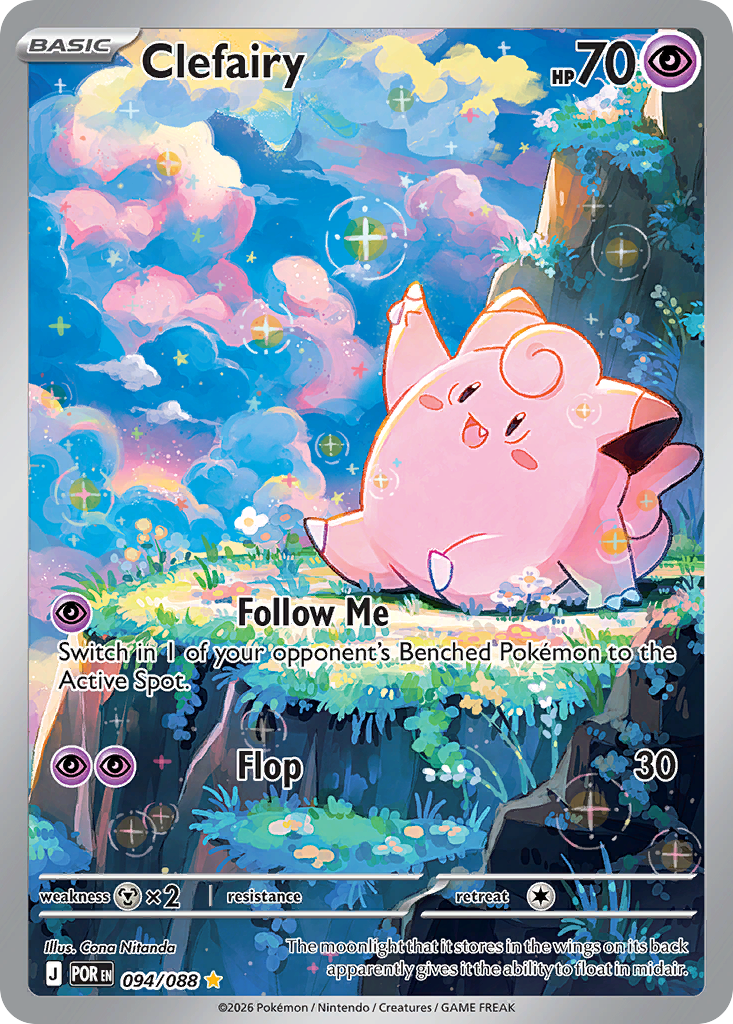
Most Pokemon card art is finished when you pull it. This one is not. The Clefairy illustration rare from Mega Evolution: Perfect Order, card 94 of 88, is the bottom half of a painting that Cona Nitanda spread across two different cards at two different rarities. The top half is Mega Clefable ex, card 119. Own one and you have a lovely card. Own both and stack them in the right order and you have something almost nothing else in a binder does.
The art
Clefairy is caught mid tumble over a flowering bank, one foot off the ground, ears thrown back, that little curl of hair leading the motion. Nitanda paints the sky behind it as a bank of pastel cumulus in pink, cream, and pale blue, then scatters the whole frame with soft sparkles and drifting bubbles that catch the light. The lower third drops into cooler greens and deep blues where the meadow folds into water and moss, and a dark mossy rock face closes the composition on the right edge. That dark edge matters. It is the wall of the scene, and it tells you which way the picture is meant to face.
The card's flavor text does the setup work: Clefairy stores moonlight in the wings on its back, which is what lets it float. So this is not a Clefairy falling. It is a Clefairy that has just gone weightless.
Then look up. On Mega Clefable ex, Nitanda paints the same sky from above. Clefable is huge in the frame, wings spread in translucent pink and green, a burst of white light blowing out the upper right corner, and along the bottom edge of the card sits the same bank of pastel cloud in the same pinks and blues and creams. Its Ability is Luminous Wing. Its attack is Shooting Moons. The moonlight that the Clefairy flavor text mentions has a source, and the source is printed on a different card.
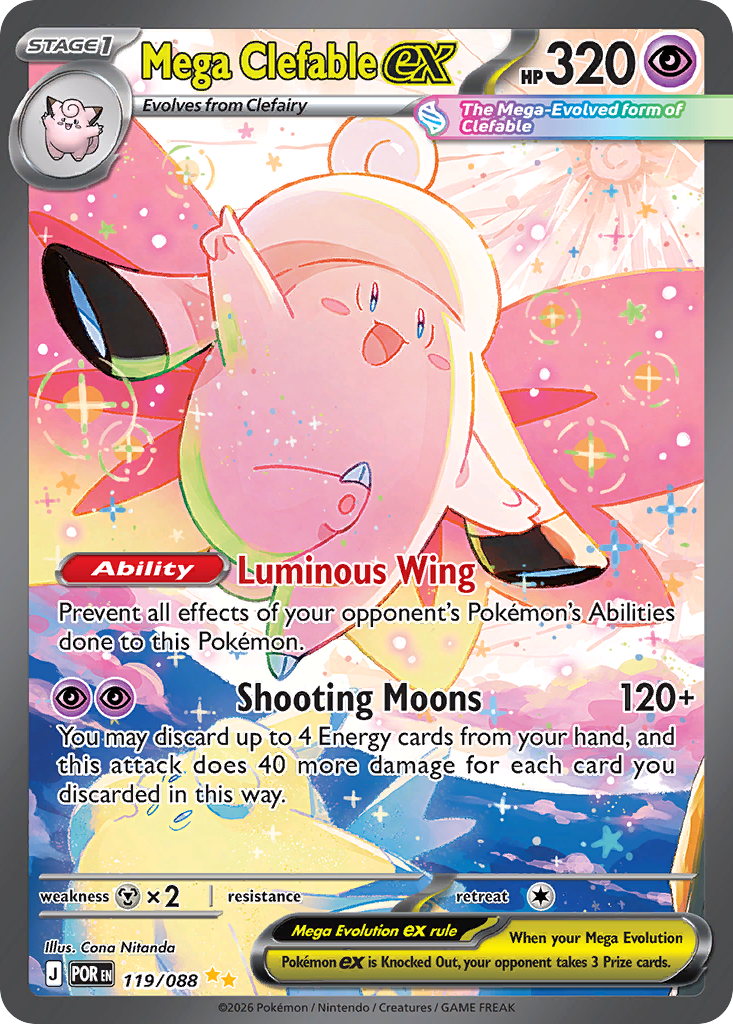
Bulbapedia records the combined illustration on both cards' entries, and stacking the two confirms it: the cloudbank runs across the seam, Clefable is airborne above, Clefairy is on the ground below. It is a vertical panorama, not a side by side spread, which is the detail most people get wrong when they first hear about it.
Worth being precise about the rarities, because they are not the same. Clefairy 94 is an illustration rare. Mega Clefable ex 119 is a special illustration rare. An illustration rare is the lower of the two: the art fills the frame but the card is a normal single prize Pokemon at a rarity you can realistically pull. A special illustration rare is the chase treatment reserved for ex cards. Nitanda drew both halves, which means the painting deliberately crosses a rarity line. The cheap card is not a lesser version of the expensive one. It is the other half of it.
Why it is trending
Honest answer first: this is a quiet week for card art news, and this Clefairy is not spiking. Perfect Order came out on March 27, 2026, and the card has settled in as one of the calmer illustration rares in it. PriceCharting has the raw Clefairy at 25.80 dollars as of today, and the Mega Clefable ex special illustration rare at 58.21 dollars. Nothing is on fire.
The reason to put it up this week is the contrast. Pitch Black lands on July 17, two days from now, and every feed is pointed at Akira Egawa's Mega Darkrai ex special illustration rare, which is a genuinely spectacular card and will be the only thing anyone talks about for a fortnight. That is the normal shape of card art attention: the loudest chase card in the newest set takes all the oxygen, and the quiet stuff in the set from four months ago goes into a bulk box.
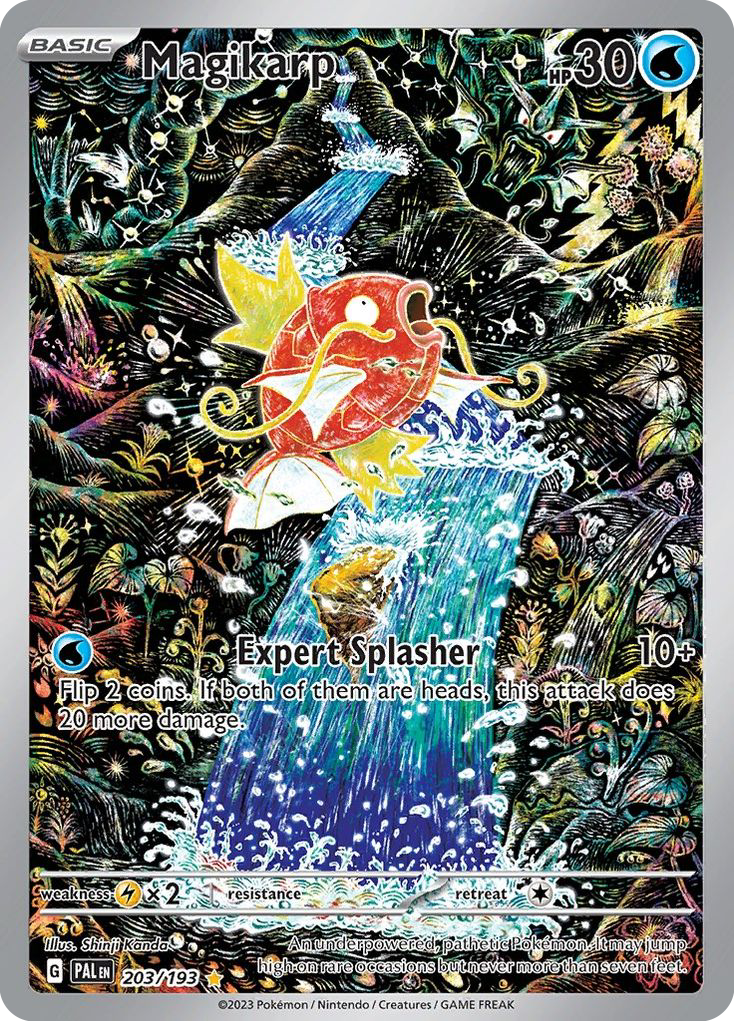
Connected art is the exception that keeps its value for a different reason. It is one of the few gimmicks that gives you a reason to buy the second card, because the first one is incomplete without it. That pull is real and it does not depend on a launch window. A single chase card competes with the next chase card. A pair like this competes with nothing, because the only way to finish the picture is to finish the picture. For a card you intend to look at rather than flip, that is a better argument than a hype cycle, and it is the same argument the Magikarp illustration rare made when art beat rarity outright.
Build a binder page around it
This is the rare card where the binder layout is not a preference. It is the point.
The two cards go in the same column, Mega Clefable ex directly above Clefairy, so the cloudbank lines up across the pocket seam. In a nine pocket page that means one column and two adjacent rows, and you want them in the middle column if you can spare it, because a page edge crops the panorama's breathing room. Do not split them across a page turn. The whole illustration dies the moment you have to flip to see the other half. If you are running a master set page where the numbers force 94 and 119 apart, this is the one time it is worth breaking the numeric order and letting the art win.
For the third pocket in that column, and the six around it, the palette does the choosing. Nitanda's scene is pastel pink, cream, and pale blue over a cool green base, so it sits beautifully next to other soft fairy and psychic art rather than anything saturated or dark. The Mega Floette ex special illustration rare is the natural neighbor, same family of pinks and prism light. Reach for the color sort in Binder Builders and let the pinks cluster, then drop the Clefable and Clefairy pair into the column you have built and see where the eye lands. If you would rather work out the ordering rules before you commit sleeves to it, the guide to organizing Pokemon cards in a binder covers when to sort by set, by color, and by artist, which is the decision this pair forces early.
One more layout note. Because Clefable's light burst sits in its upper right and Clefairy's dark rock closes the lower right, the pair has a diagonal running through it from bright to dark. Put nothing loud on the right of that column. Let it fall off into something quiet.
The takeaway
The lesson here is cheap to act on. A twenty six dollar illustration rare is doing something a thousand dollar chase card cannot: it is asking for a second card and a specific arrangement. If you build binder pages around art rather than price, hunt for the pairs. Connected illustrations are the only cards where your layout decision is part of the artwork, and where getting the order right is the difference between two nice cards and one finished painting. Nitanda gave you the picture in two pieces. The binder is where you put it back together.