Most illustration rares want you to see the Pokemon. Raita Kazama drew Lycanroc 138 of 128 so that you almost do not. Midnight Form comes through the frame mid lunge, half of it cut away by black diagonals, the rest buried under broken glass and streaks of pale light. Seven weeks after 30th Celebration launched it is still the card in the set that collectors argue about, and the argument is the reason to look closer.
The art
Start with what is missing. There is no sky, no horizon, no ground plane, and no readable location. The background is a deep violet field with blurred shapes glowing behind it, out of focus pale columns and small blocks of cyan that read like lit windows seen at speed. Kazama never resolves them. You are told there is a city, or a corridor, or a room, and then denied the chance to check.
Over that he lays two systems of debris. The first is a set of hard black diagonals running from lower left to upper right, wide enough to swallow the Pokemon's shoulder and jaw in places. The second is a scatter of angular shards, black triangles alongside fragments that catch pale pink, mint and a thin gold, the way a broken edge catches a light source off camera. Then pale blue and white streaks cut across everything at the same diagonal. The whole card moves in one direction, and the Pokemon moves with it.
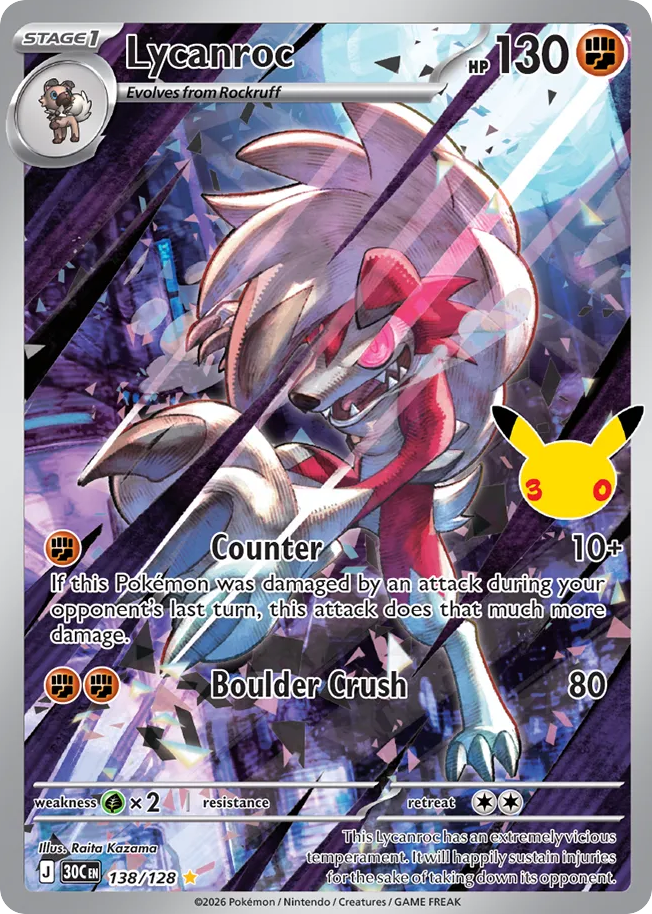
Lycanroc itself is drawn with harder line work than most of the set. The white fur is built out of visible directional strokes, and the mane tufts end in sawtooth edges rather than soft points, so the Pokemon reads as cut paper more than as an animal. The red of the mane and chest is the only warm colour on the card and it is used sparingly. The one eye you can see glows magenta inside a pale ring, the mouth is open on white fangs, and the claws come through in cold blue grey at the bottom of the frame. Reading the whole creature at a glance was never the goal.
The card text agrees with the picture. Counter does 10 damage plus whatever your opponent dealt you last turn, Boulder Crush does 80, and the flavour text says this Lycanroc will happily sustain injuries for the sake of taking down its opponent. A card about absorbing a hit and sending it back is a reasonable thing to draw as shattering glass.
Note the yellow Pikachu silhouette stamped into the lower right of the artwork with 30 on its face. Every illustration rare in this set carries it, which is a real constraint: the artist has to leave a bright, opaque, unmovable object in that corner. Kazama answers it by pointing the lunge away, so the stamp sits in the quietest part of the frame.
Kazama is four cards into the Pokemon TCG. Serebii's artist index lists all of them: Mega Gardevoir ex 178 of 132 in Mega Evolution, Cresselia 39 of 94 in Phantasmal Flames, N's Zoroark ex 286 of 217 in Ascended Heroes, and this Lycanroc. Two of those are special illustration rares and one is an uncommon, which makes 138 his first ordinary illustration rare, and the first time he has had to design around attack text printed over the painting. Outside the card game he is a character designer with credits on Xenoblade, Xenoblade X, Puzzle and Dragons, Border Break, Brigandine: The Legend of Runersia, and Mercenaries Wings. The hard edged, slightly armoured look on this Lycanroc is that career showing up on a Pokemon card.
Why it is trending
Delta Reign arrives on November 6, 2026, which means this is the last week 30th Celebration is the newest English set. That is when people stop opening and start ranking, and the rankings for this set keep snagging on the same card.
The split is on the record and it is wide. Thornberry Media called it "one of the most dramatic Illustration Rares revealed for 30th Celebration so far." Rare Candy described it as Midnight Lycanroc cutting "across a shattered, glass like background, all sharp angles and cold blue light." ComicBook.com put it eleventh out of thirteen cards it had seen, with the complaint stated plainly: "I feel like the whole card is a bit too dark to really showcase the Pokemon properly," and a follow up that an illustration rare wants more contrast between the Pokemon and its background so the star can shine.
Both readings are defensible, which is unusual. Most divisive cards are divisive because the art is lazy. This one is divisive because the artist made a choice that costs something real. You trade legibility for motion, and whether that was worth it depends on whether you want a card to be read from across a table or held under a lamp.
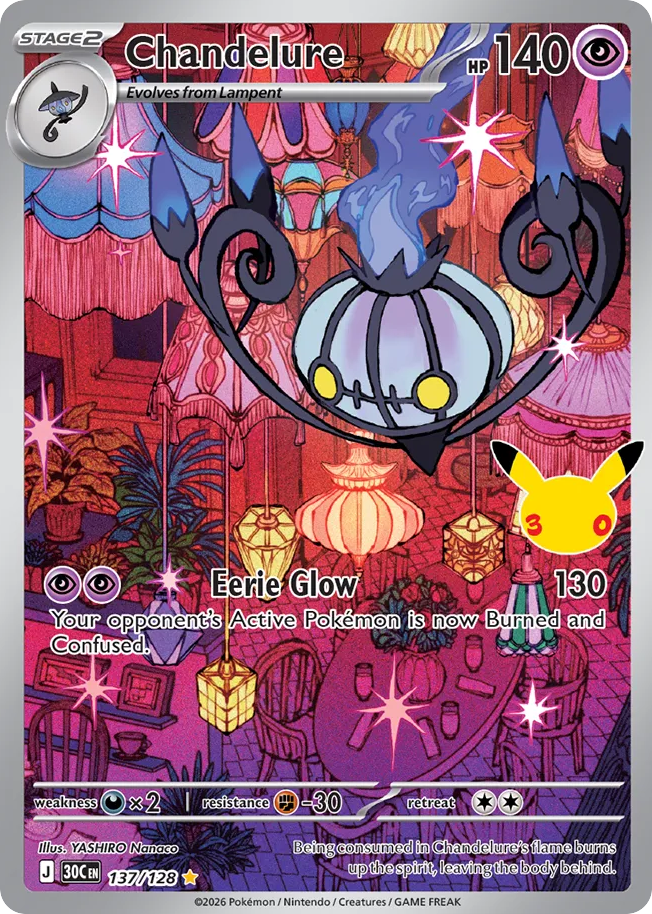
Prices say the market has not decided either. Pulled from PriceCharting on November 4, 2026, Lycanroc 138 sits at $2.99 ungraded, $12.66 in a grade 9, and $40.09 in a PSA 10. The same day the Chandelure illustration rare from the same set was $2.58 raw, the Lapras illustration rare was $6.27, and the Gengar ex special illustration rare was $71.33. Nothing here is a frenzy. Three dollar cards on a seven week old set are noise, so buy it because you want to look at it rather than because the number is going anywhere.
Build a binder page around it
This card has a direction, and almost nobody places it accordingly. The lunge travels from lower left to upper right and leaves the frame, so a centre pocket fights it. Put it in the left column instead and let the motion run into the page. Bottom left of a nine pocket spread is the strongest slot: it is where the eye lands last, and a diagonal composition rewards that.
Then deal with the darkness, because that is the real problem. A card this dark dies in a bright row. Drop it between two sunlit illustration rares and the blacks go flat and the shards stop reading as glass. The colour sort in Binder Builders will put it in the violet and purple band, and that band is where it belongs: surround it with deep purple, navy and near black cards and the pale streaks become the only light source on the page, which is the effect the artist actually drew.
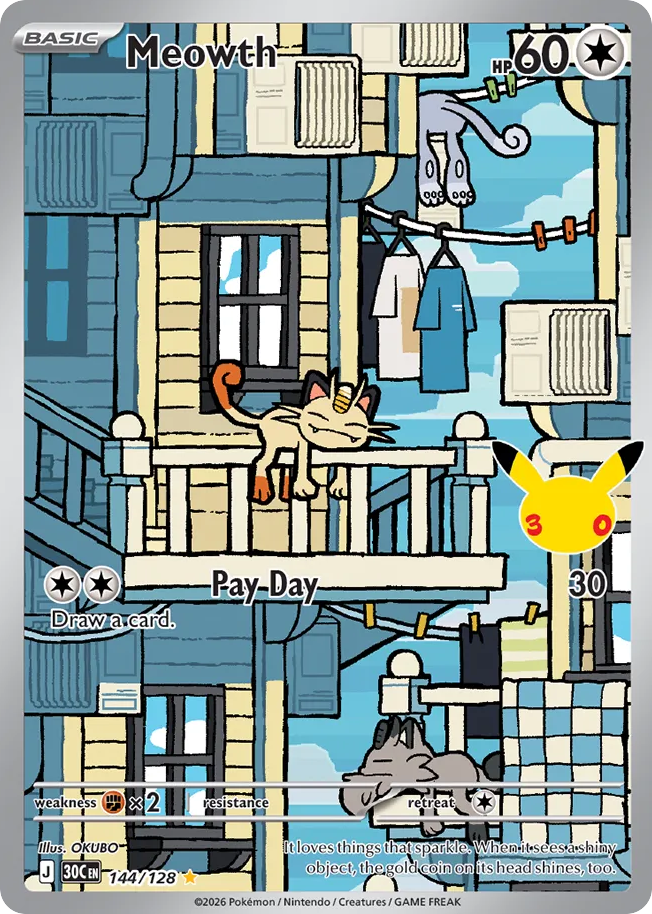
Resist the master set instinct here. In strict number order 138 lands immediately after Chandelure 137, and that card is a wall of hot magenta. Both are excellent and they ruin each other side by side. The same tension runs through this set, which splits its artwork across bright and dark scenes, so the day and night Pikachu ex pair is worth keeping together while most numeric neighbours are not. Numeric order and visual order are two different binders, and the fix is to pick one on purpose. Our guide to how to organize Pokemon cards in a binder covers both systems and what each one costs you.
One practical note. Dark cards suffer most behind a cloudy or tinted pocket, because there is no bright colour left to carry through the haze. If you own one good set of pages, this is the card that should go in them.
The takeaway
A card that half the internet calls too dark is usually a card nobody has given the right background. Lycanroc 138 is a three dollar illustration rare drawn by a game artist on his first ordinary full art, and it is built on an actual idea: a Pokemon that counterattacks, drawn as the moment the glass breaks. Open the builder, run the colour sort, and put it in the left column of your darkest page with nothing bright near it. It stops being the card people argue about and starts being the one they stop on.