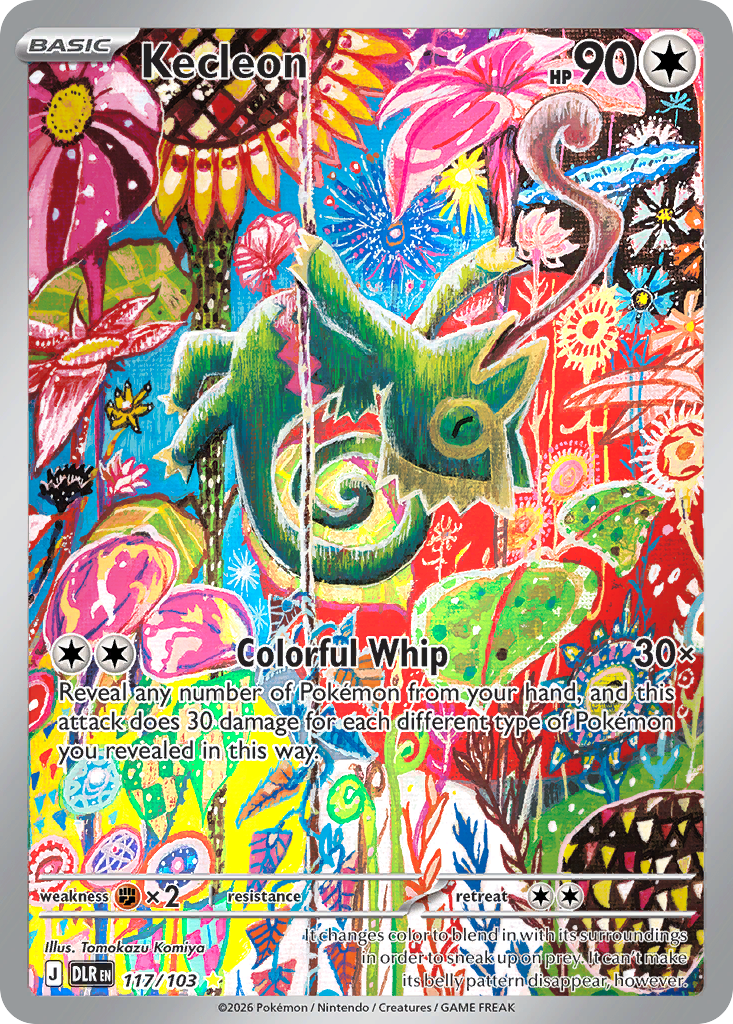
Delta Reign landed on November 6, 2026 with six special illustration rares sitting at the top of the set, and the card the art crowd keeps pulling back out is one rarity tier below all of them. Number 117 of 103 is a Kecleon, illustrated by Tomokazu Komiya. It is the most expensive illustration rare in the set by a wide margin and it beats half the SIRs printed above it. The painting is the entire reason.
The art
An illustration rare, or IR, is the tier directly under a special illustration rare. The artwork runs full bleed with no inset window, the subject is an ordinary Pokemon rather than an ex, and the card earns its slot on the picture alone. Delta Reign prints fourteen of them, numbered 104 through 117, and every single one went to a different illustrator. Komiya drew the last card in the run.
The frame is a wall of flowers, edge to edge, with no ground and no horizon anywhere. Cobalt blue stands in for sky and you only see it in three or four gaps near the top. A magenta coneflower leans in from the left with a yellow dotted center and white speckles flicked across its petals. Beside it a second bloom opens out of a dark crosshatched lattice in deep brown and red. The bottom third turns acid yellow and fills up with blue leaf shapes, pink loops and a brown trellis of branches. Nothing on this card is rendered. It looks worked in oil pastel over textured stock, and the tooth of the paper shows through almost every stroke.
Kecleon sits in the middle and takes a second to find. Komiya paints it in vertical green strokes running the same direction as the leaves around it, dark forest green through the back, a yellower green along the top edge. The tail curls into a flat spiral under the body. The eye is a gold ring with a black comma for a pupil. A pale flower stem crosses straight down over the whole body, so a piece of the background sits in front of the Pokemon instead of behind it.
Then there is the belly stripe. Kecleon's zigzag is the one marking that gives it away, and the card says as much in its own Pokedex line at the bottom: "It changes color to blend in with its surroundings in order to sneak up on prey. It can't make its belly pattern disappear, however." Komiya paints that zigzag in mustard gold, and the same mustard gold turns up in the flower centers and in the leaf strokes along the bottom edge. He hid the one thing the card text says cannot be hidden.
Worth putting next to it: Mori Yuu drew a Kecleon illustration rare for Surging Sparks in November 2024, card 213 of 191, and it runs the same camouflage idea. Pale green Kecleon, wall of green jungle leaves, four more Kecleon tucked into the corners. But Mori Yuu keeps the belly zigzag red and loud, exactly as written. Two years later Komiya takes the same premise and breaks the rule it was built on.
There is a safety net. A thin white keyline traces the silhouette so the Pokemon stays readable. Take it away and the card becomes a flower painting with a rumor of a chameleon in it. The attack fits too. It is called Colorful Whip and it does 30 damage for every different type of Pokemon you reveal from your hand, so the card pays out on variety of color.
This is a different gear from the Komiya most collectors know. His usual move, covered in our Tomokazu Komiya artist feature, is a deformed subject in unusual tones that pops hard off its background. Brute Bonnet in Paradox Rift and Baxcalibur in Paldea Evolved both work that way. Here he aims the same loud palette at the background and lets the Pokemon sink into it.
Why it is trending
The numbers are the story. Reading market prices across TCGWatchtower, Bill's Archive and DeckTradr on November 18, 2026, Kecleon 117 sits at about $30.00. The next illustration rare in the set is Eevee at $23.51, then Groudon at $17.43, and the median across the fourteen lands somewhere around $6 or $7. Masquerain, the floor of the tier, is $1.67.
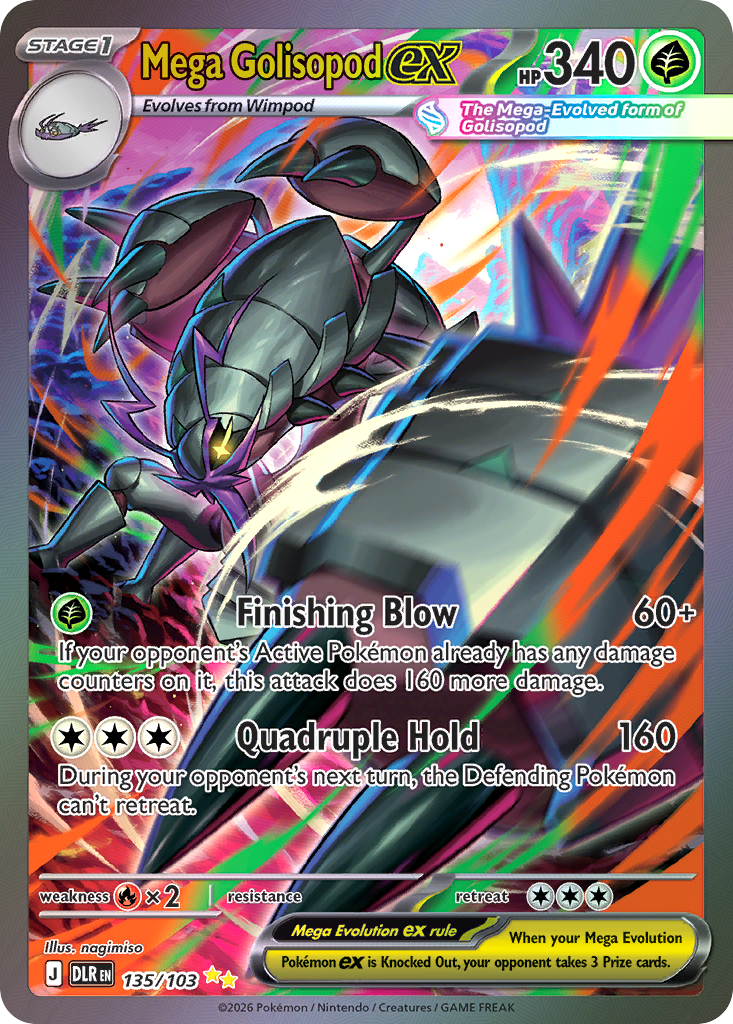
Now look up a rarity. Of the six special illustration rares in Delta Reign, Kecleon outprices three: Aarune at $20.97, nagimiso's Mega Golisopod ex at $25.96, and Mega Golurk ex at $27.63. Zinnia's Trust at $31.79 is ahead of it by $1.79. A plain illustration rare of a Pokemon that does not evolve and never sees play is trading inside the SIR tier.
The supply side explains it. Komiya has 252 cards in the Pokemon TCG API, and 182 of them are Commons or Uncommons. He has seven illustration rares across his whole career and he has never once been handed a special illustration rare. Kecleon is his first top rarity card since Karrablast in Black Bolt in July 2025, a sixteen month gap. People who collect this illustrator have almost nowhere to spend money, so when a slot opens the demand lands on one card.
Be honest about the hype. The set is twelve days old and new illustration rares almost always soften as supply opens up. Brute Bonnet, the Komiya IR everyone points to, reads about $15.88 raw three years after Paradox Rift. Buy this one for the painting and treat anything else as a bonus.
Build a binder page around it
Color sorting will fight you here, and it is worth knowing before you drop the card in. The subject is green but the card averages out magenta, yellow and red, so an automatic sort puts Kecleon in the warm run rather than next to your grass types. Place this one by eye.
The page that really works is a Komiya illustration rare page, and the math is unusually tidy. He has exactly seven: Drowzee from Scarlet and Violet, Frigibax, Arctibax and Baxcalibur from Paldea Evolved, Brute Bonnet from Paradox Rift, Karrablast from Black Bolt, and now Kecleon. Seven cards fit in a nine pocket page with two slots left over. Lay them out in release order from the top left so the page reads chronologically, and leave the last two pockets empty for whatever he gets next. A page with room still on it is a better page than a full one, because it gives you something to chase.
If you would rather build around the picture than the signature, the other option is a flower page. Nine cards whose art is carried by plants rather than by the Pokemon, with Kecleon in the center pocket as the one that hides its subject. That page sorts beautifully by hue and it stays readable at arm's length, which is the test any spread has to pass. Our guide to organizing a Pokemon binder walks through both the artist grouping and the color sorting if you want the fundamentals first, and you can lay either page out in the builder before you buy a single card.
One sleeving note. The art runs to all four edges with heavy pigment in the corners, so any whitening shows up immediately against the yellow and magenta. Decide where it lives once and then leave it alone.
The useful lesson from card 117 is that the rarity symbol tells you how hard a card was to pull and nothing at all about how good it is. Komiya got the cheapest slot in the high rarity run, filled it with a painting that argues with the Pokedex line printed two inches below it, and ended up with a card worth more than three of the six the set built its box around. When you are choosing what goes in your binder, the signature is a better filter than the star.