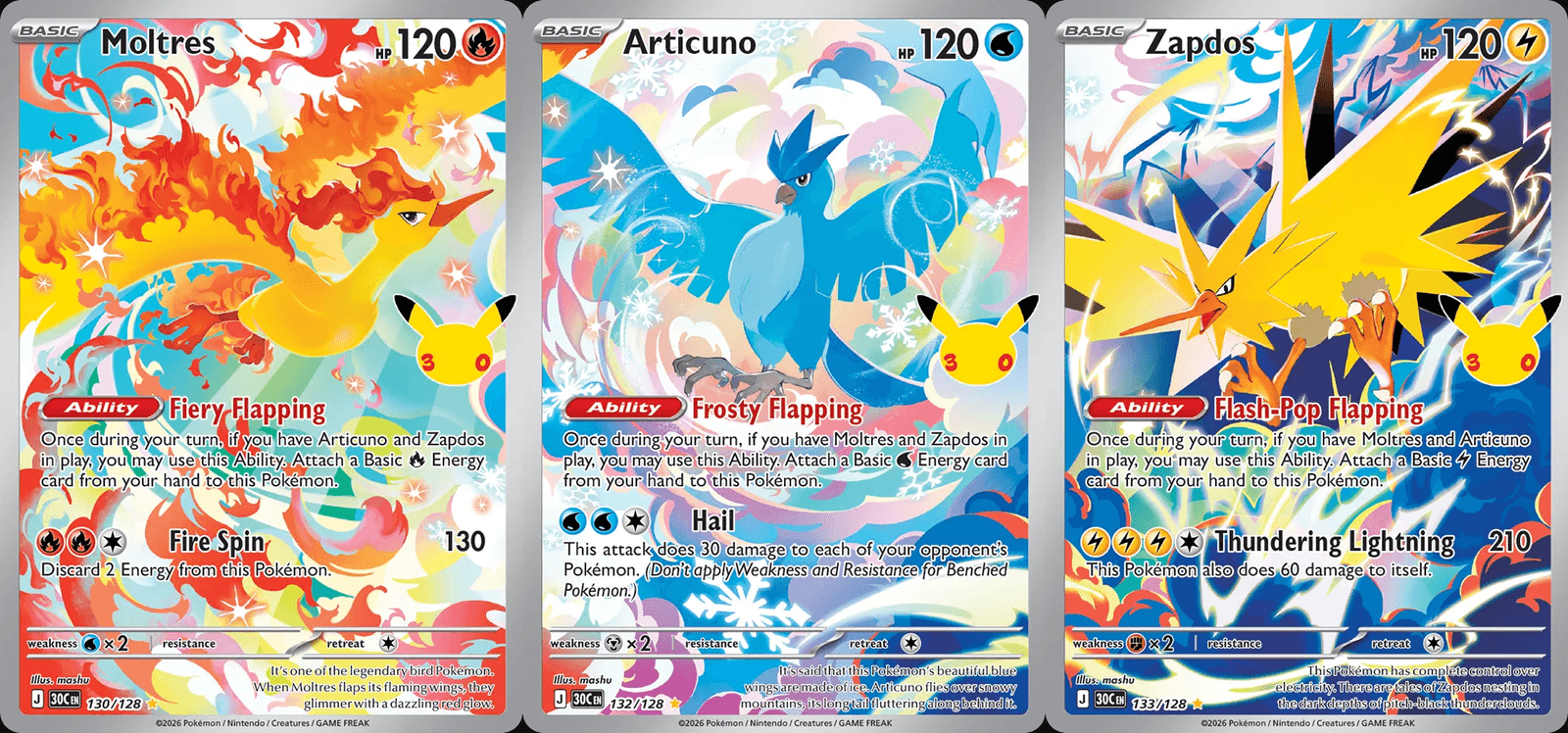
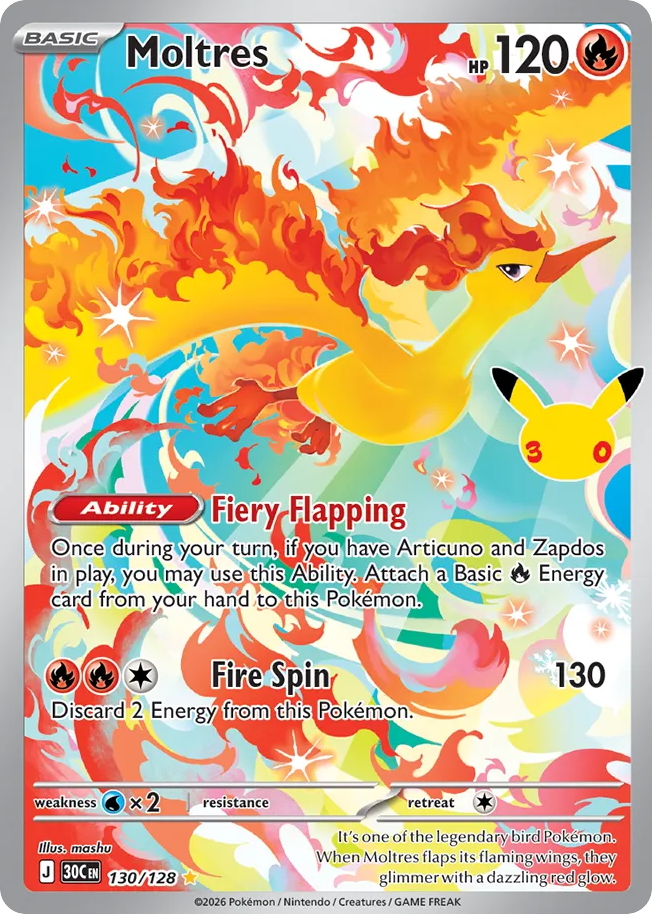
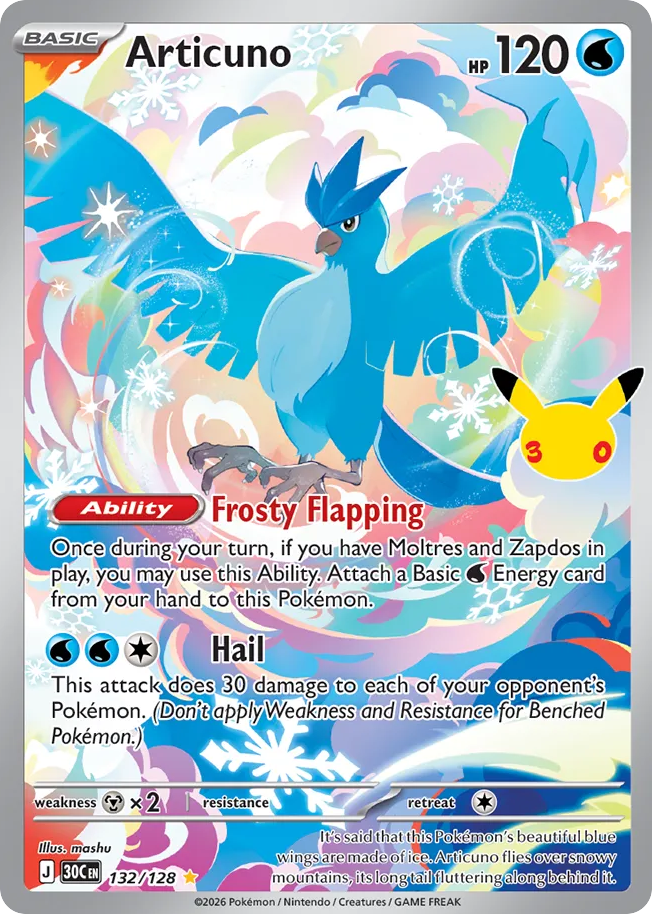
Three cards in 30th Celebration share an illustrator, a rarity, a color palette, and an Ability that does nothing unless the other two are on the table. Moltres 130, Articuno 132 and Zapdos 133 are the Kanto legendary birds as illustration rares, all three drawn by mashu, and the art is built to be read left to right as one row. A single bird is a nice pull. Three birds in a line is the reason people are hunting them.
The art
Start on the left. Moltres flies to the right, beak first, its flame plumage unspooling behind it in ribbons of red and orange that look painted with a flat brush rather than rendered. The background is not a sky. It is a field of overlapping pastel shapes, mint and peach and pale blue, with hard edged white sparkle bursts scattered through it. Nothing about the scene tries to be realistic, which is the point. mashu is drawing the idea of a firebird rather than a bird on fire.
Articuno takes the center and faces you directly, wings thrown wide and symmetrical, the only one of the three in a head on pose. Its blues are the coolest thing in the whole triptych and mashu clears the space around it, letting the pastel cloudbank go almost white behind the wings so the bird reads as a silhouette. Snowflakes sit on top of the art as flat white graphics, and a ring of icy sparkle curls under the left wing.
Zapdos closes the row facing back to the left, into Articuno. This is the dark card of the three. The background drops into deep navy and black wedges, the crackle shapes go angular and shattered, and the yellow is pushed to full saturation so the bird burns out of the frame. Put the three side by side and the whole row runs warm to cool to dark, with Articuno as the bright pivot in the middle.
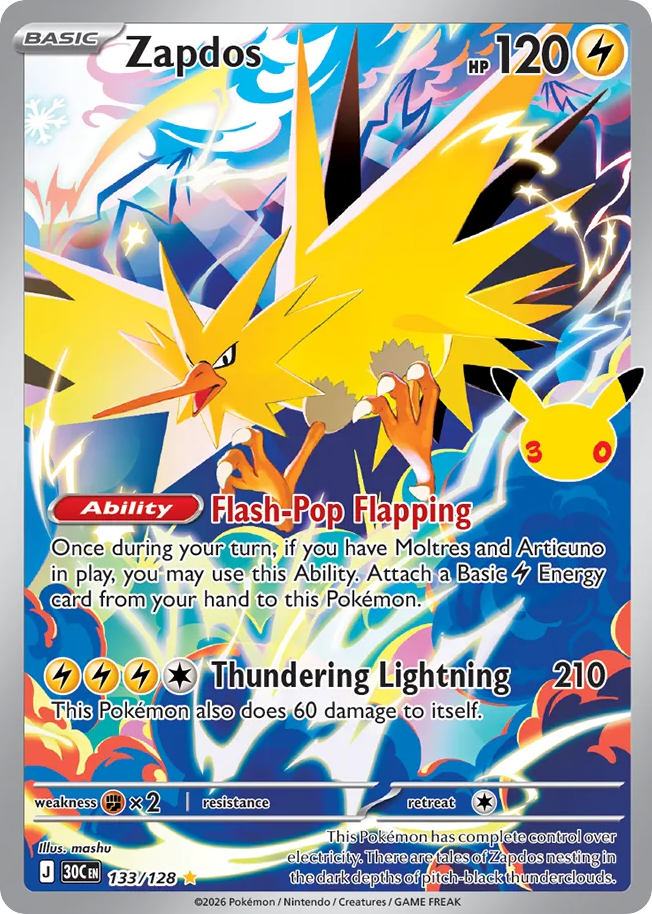
The connection is real, and it is worth being precise about what kind. These are three separate full art cards with their own silver frames, so this is not a single painting sliced into thirds. What carries across the seams is the scene. Stack Articuno next to Zapdos and Articuno's pastel cloud puffs and snowflakes continue onto Zapdos's left edge. Stack Moltres next to Articuno and the flame oranges bleed into Articuno's top left corner while the same teal wedge crosses the gap. The two outer birds face inward. The middle one faces out. That is a triptych composition, built deliberately, and it collapses the moment you separate them.
The card text agrees with the art. Each bird is 120 HP with an Ability named for its element: Fiery Flapping, Frosty Flapping, Flash-Pop Flapping. Each one reads the same way, that you may attach a basic Energy of that type only if the other two legendary birds are in play. The illustrator and the game designer arrived at the same instruction.
Why it is trending
30th Celebration launched on September 16, 2026, the first Pokemon TCG expansion to release simultaneously worldwide, and a week later the set is still the only thing anyone is opening. Writing for TCGplayer the day before release, Peter Day put these three at number seven in a list of the ten cards everybody wants from the set, and the reason given was the art rather than the play.
Connected art has history here, and the birds have done this before. In 2009's Supreme Victors, Articuno, Zapdos and Moltres each received a secret rare, cards 148, 149 and 150, and all three were illustrated by Toshinao Aoki. One artist, three cards, one scene. Seventeen years later 30th Celebration runs the same play with mashu, and the older trio has aged into some of the most expensive cards those three Pokemon have ever had.
mashu is the other half of the story. Their first English card was a plain Galvantula uncommon in Shrouded Fable on August 2, 2024, which makes this a short catalog by Pokemon TCG standards. In two years it has gone to Terapagos ex, the special illustration rare in Prismatic Evolutions, and then to the Bulbasaur line in Mega Evolution, where mashu drew Bulbasaur 133 and Ivysaur 134 as illustration rares and Mega Venusaur ex 177 as the special illustration rare. That is the same trick as the birds, three connected cards across two rarity tiers. This illustrator clearly likes working in threes.
The honest part: the set is seven days old. Prices on a week old expansion are noise, boxes are still being opened in volume, and anyone quoting you a settled market value for a card this new is guessing. Buy these because you want to look at them.
Build a binder page around it
This is one of the rare cases where the layout is not a matter of taste. Three cards, one row, in order: Moltres left, Articuno center, Zapdos right. In a nine pocket page that is the top row, and the top row is the right call over the middle or bottom because it sits at eye level when the binder opens.
The order is not negotiable, and it is not numeric. Moltres has to be on the left because it faces right. Zapdos has to be on the right because it faces left. Articuno is the only one that works in the middle because it is the only one facing out. Get that backwards and the two outer birds stare off the edges of the page.
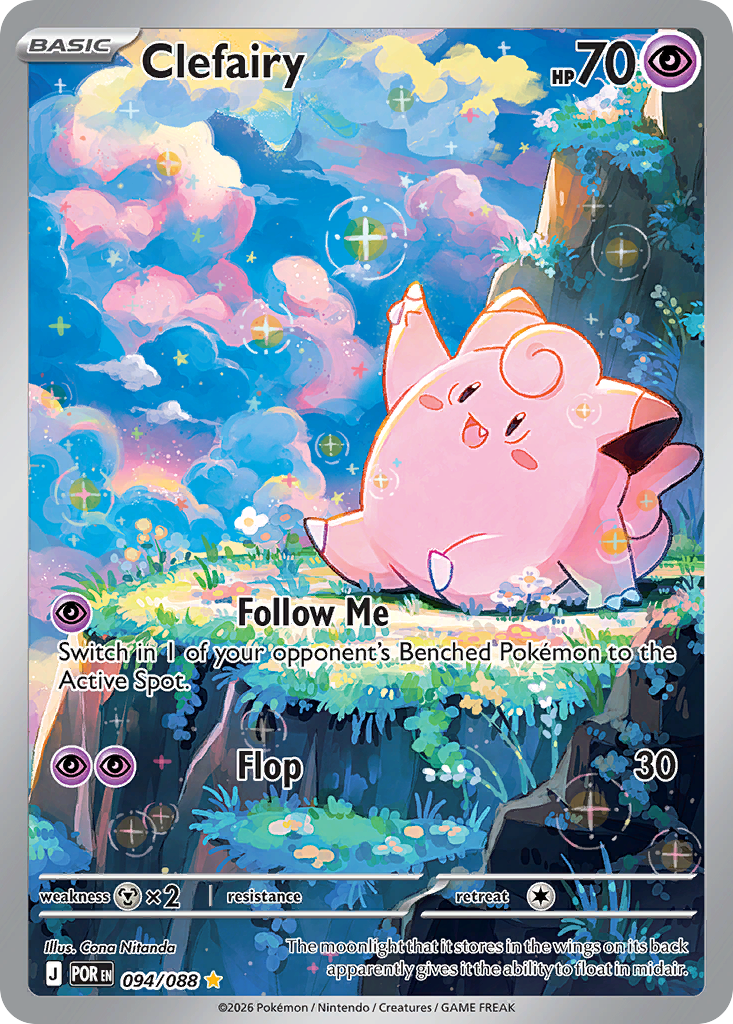
Then there is card 131, which is a Lapras illustration rare by Amelicart, and which sits directly between Moltres and Articuno in the set. Anyone sorting a 30th Celebration master set page strictly by number will drop a Lapras into the middle of the row and break it. This is the same problem our Clefairy and Mega Clefable connected art pair creates one page over, and the answer is the same: when art and numbering disagree, let the art win and put the odd card out elsewhere on the spread. The general version of that tradeoff, along with the other ways to sort a binder, is in our guide to how to organize Pokemon cards in a binder.
Two more things worth setting up. Do not split the row across a page turn, because a triptych you have to flip to finish is not a triptych. And if you run the color sort feature, these three are a gift: warm, bright, dark, left to right, which means the row doubles as a color gradient and gives the facing page something to answer.
The takeaway
Buy them as a set or do not bother. Every decision mashu made here, the facing directions, the palette running warm to cool, the cloudbank crossing the seams, only pays off when the three cards sit next to each other. A single Zapdos in a binder is one good looking card among many. The row is the thing nobody else on your shelf has. Open the builder, drop the three into a top row, and leave the space around them quiet so the gradient has somewhere to breathe.