Most artist binder pages are assembled by taste. You like the work, you pick nine cards, you argue with yourself about the tenth. This one was assembled for you back in 2004, and the hobby has mostly failed to notice. Every single Gold Star in the English Pokemon card game was drawn by the same person. Not most of them. All of them. The pokemon card illustrator responsible is Masakazu Fukuda, and almost nobody who owns one knows his name.
Who is Masakazu Fukuda
The illustrator profile at Art of PKM puts it plainly: "Mr. Fukuda is an illustrator who began working freelance after being in charge of character design and main graphics at a game production company for 11 years." He came to the Pokemon TCG already fluent in making a character read at thumbnail size, which is most of the job on a card two and a half inches wide.
His first credit in the Pokemon TCG API is a Mew from the Nintendo Black Star Promos, dated October 2003. His first booster set work landed eleven months later: Meowth, Persian and Tauros in EX FireRed and LeafGreen, September 2004. Two months after that, EX Team Rocket Returns introduced a new rarity with a small gold star printed next to the Pokemon's name, and Fukuda drew all three of them.
He then drew the next twenty four as well. Querying the API for every card with the Gold Star rarity returns 25 results and every one of them credits Masakazu Fukuda, with no exceptions and no co-credits. Add the Espeon and Umbreon from POP Series 5, which carry the gold star on the card but a different rarity label in the database, and the complete English run is 27 cards by one artist across nine expansions and roughly two and a half years.
The ceiling on that body of work is now public record. CGC reports that the only Gold Star Rayquaza it has ever graded Pristine 10 sold through Fanatics Collect's Premier auction on August 28, 2026 for $1.02 million, the first English Pokemon card to clear seven figures. Fukuda's catalog does not stop there either. The same API returns 473 English cards under his name, running through Guzma in 2017, Radiant Blastoise in 2022, and a Metagross in the 30th Celebration Classic Collection last month.
His signature style
Pull up any six of his cards side by side and one habit shows up on every one of them. The Pokemon does not stay inside the art box. It climbs out.
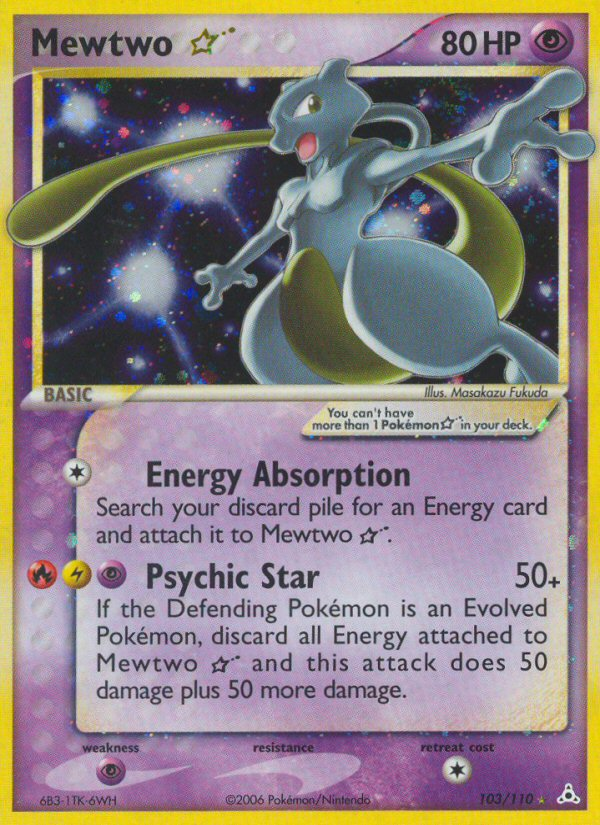
On the Mudkip, the dorsal fin crosses the top frame line. On the cover card above, a Mewtwo from EX Holon Phantoms, the tail swings across the right border while the outstretched arm crosses the left. On the Charizard both wings break the frame. On the Umbreon it is the ears. This is not an occasional flourish, it is the rule, and it is what gives the Gold Stars their particular sense of a creature that is too big for the card it has been printed on.
The habit survived the format changes. By 2017 Fukuda was drawing full art Supporters, where there is no frame to break, so Guzma leans out over his own rules text instead. By 2022 the Radiant treatment had given him a thin yellow border, and Blastoise promptly put a water cannon and a front foot through it. Eighteen years, three completely different card layouts, same instinct.
The second tell is the background. He almost never gives you a place. The Gold Stars sit in abstract fields of holo foil and colored light rather than a forest or a cave, which is the opposite of how a modern Illustration Rare is built, and it is why they still look like a special rarity rather than a scene. Compare that to the environment-first approach in our Shibuzoh. artist feature, where the room usually outranks the Pokemon, and the contrast is immediate.
Cards to know
Five from the catalog, in release order, every one credited on the printed card to Illus. Masakazu Fukuda.
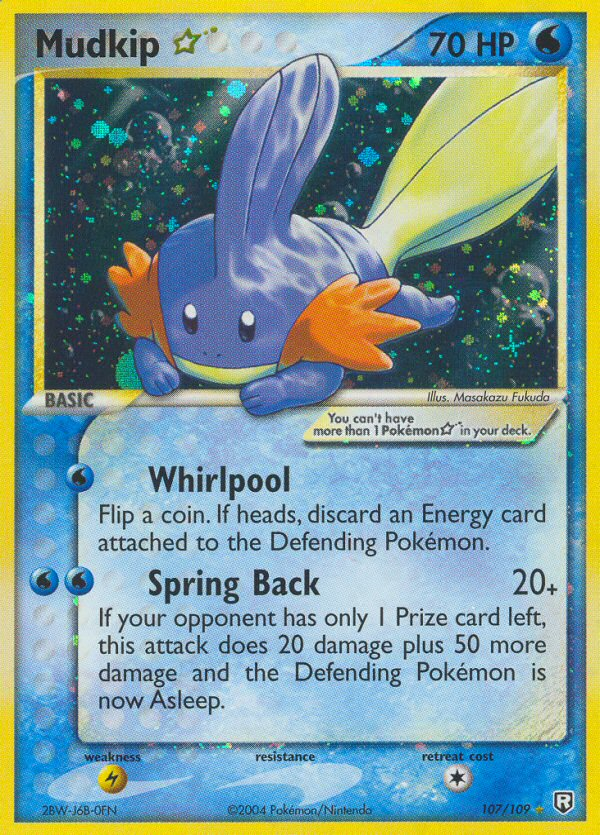
Mudkip Gold Star, EX Team Rocket Returns 107/109. The first number in the first Gold Star trio, which makes this the card that opened the whole run. It is also the gentlest thing on the list. Mudkip is just sitting there in a field of blue bubbles and foil, which makes the fin crossing the top border the only aggressive mark on the card.
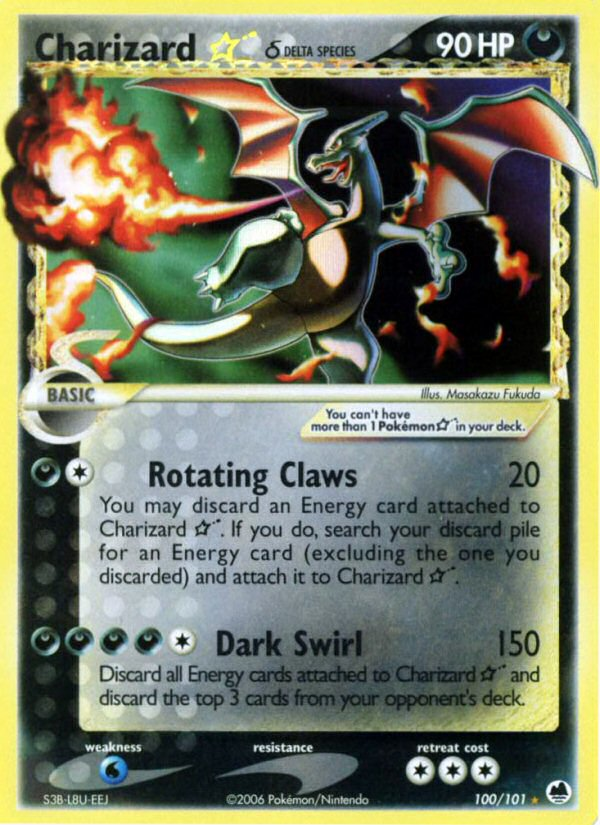
Charizard Gold Star Delta Species, EX Dragon Frontiers 100/101. The Delta Species treatment recolored Charizard a dark green black with a pale cream underside, and Fukuda lit the whole card from a single fireball in the upper left with loose flame fragments scattered across the right. Both wings leave the frame. The body is angled hard enough that you read the pose before you read the Pokemon.
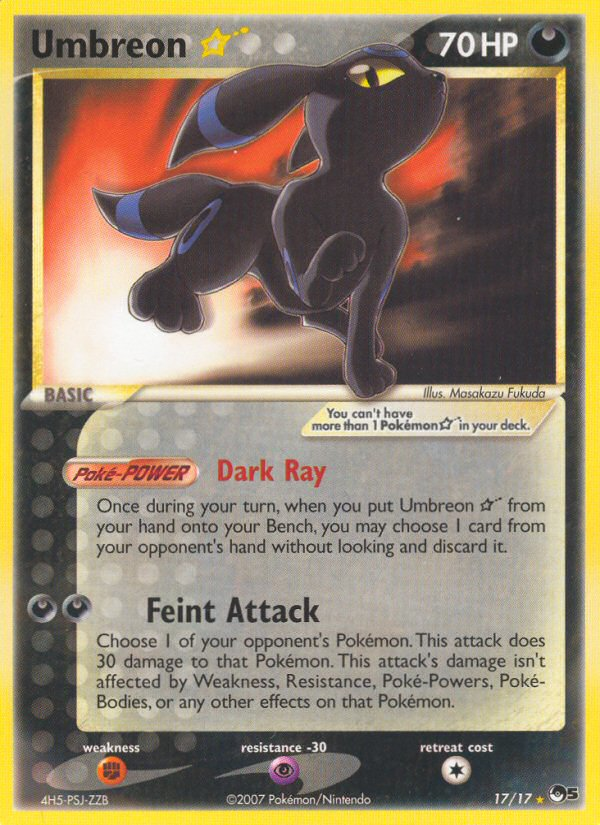
Umbreon Gold Star, POP Series 5 17/17. Mid stride against a smear of orange and red, with every ring on the body picked out in the same blue and no attempt at a setting behind it. The ears cross the top of the frame. It is the last card in a seventeen card promo series rather than a booster expansion, and the Espeon at 16/17 is its only company there.
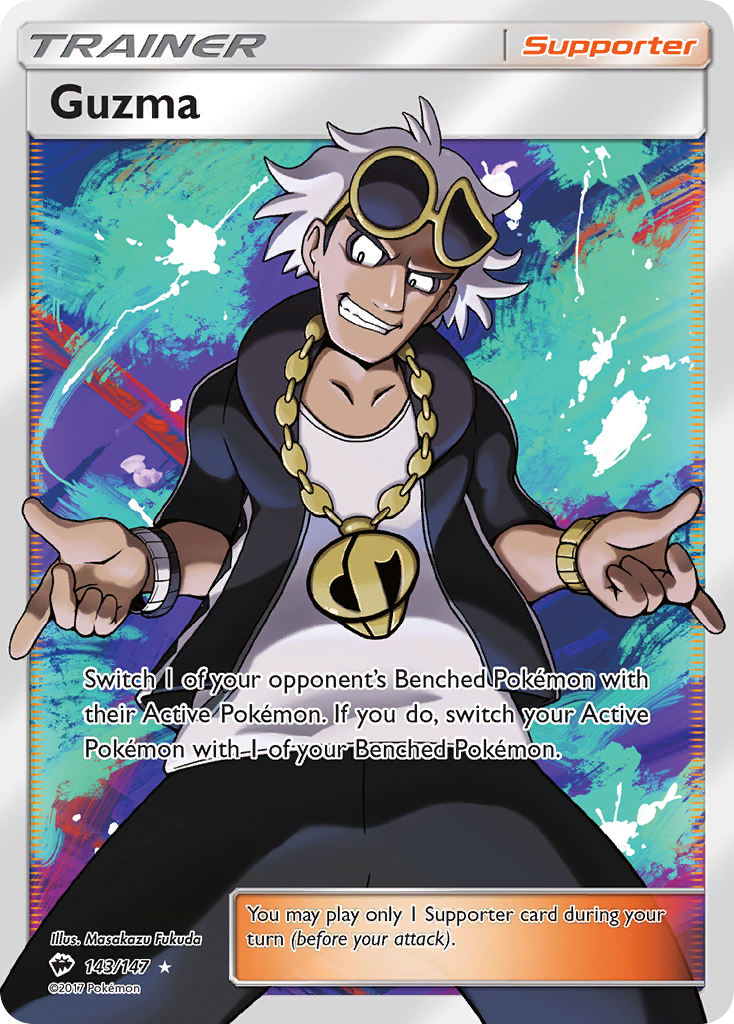
Guzma, Burning Shadows 143/147. Proof that the frame break was never really about the frame. Guzma is shot from below with both hands out, shoulders past the edge of the panel, grin aimed straight at you, over a background of loose teal and purple brushwork and white paint spatter. It is the loudest Supporter art of its era and it is by the Gold Star guy.
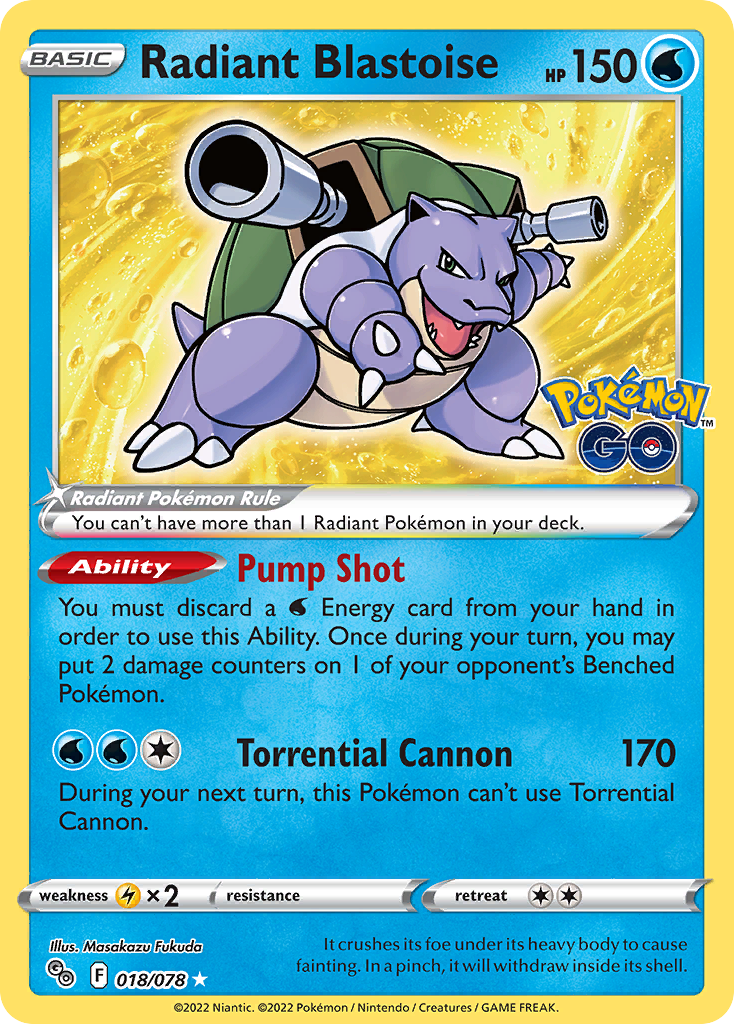
Radiant Blastoise, Pokemon GO 018/078. Fifteen years after the Gold Stars, on a different rarity with a different border, Fukuda does the same thing: cannon through the top left corner, front foot through the bottom, and a field of molten gold behind it instead of a location.
Build a Gold Star binder page
Twenty seven cards. Nine pockets a page. The complete English Gold Star run fits three pages exactly, with nothing left over, which almost never happens with a collecting goal this famous. It is the cleanest finish line in the hobby and it is also one of the most expensive, so treat it as a layout to plan now and fill slowly.
The run organizes itself, because the sets handed them out in threes. Team Rocket Returns gave the Hoenn starters, EX Deoxys gave Latias, Latios and Rayquaza, Unseen Forces gave the legendary beasts, Delta Species gave Groudon, Kyogre and Metagross, and Legend Maker gave the Regi trio. Five sets, five clean rows. Put each trio in its own row and the pages read as the sets did.
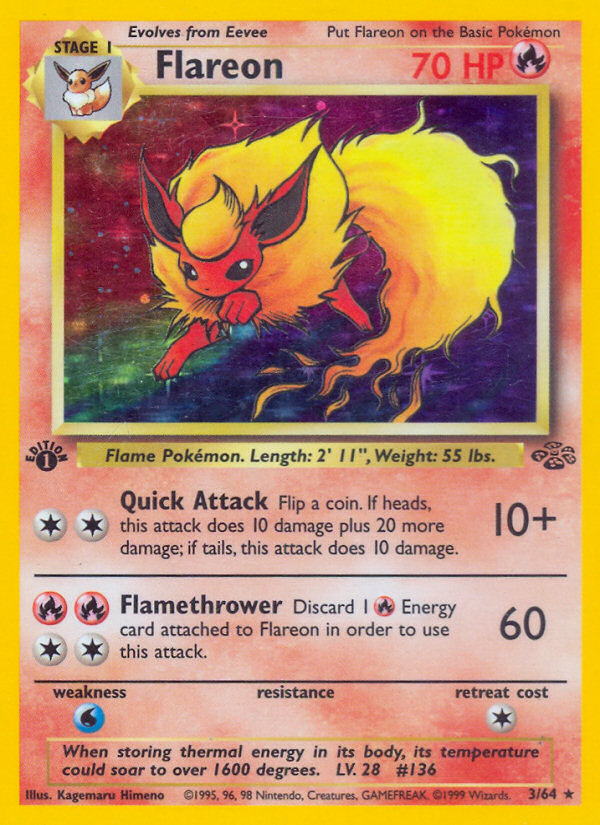
That leaves the awkward twelve, and they are the interesting ones. Holon Phantoms gave three with no theme holding them together, Gyarados, Mewtwo and Pikachu. Crystal Guardians gave two. Dragon Frontiers gave two. Then Power Keepers and POP Series 5 between them completed all five of the original Eeveelutions: Flareon, Jolteon and Vaporeon from the set, Espeon and Umbreon from the promo series. A row of three plus a stranded pair is a worse fit than a row of five, so the honest move on page three is to break chronology and give the Eeveelutions their own run across the middle. Our guide to organizing a Pokemon binder covers when to abandon set order for a stronger grouping, and this is the textbook case.
One practical note. If three pages of seven figure vintage is not a realistic goal, the same layout works as a want list. Drag the 27 slots into Binder Builders, label them, and fill what you can. A page with holes in it that you can see is a better collecting tool than a list in your notes app. For a vintage artist page you can actually finish this year, the Kagemaru Himeno feature is the place to start.
Fukuda has drawn 473 English cards and the hobby knows him for 27 of them. That is a fair trade, because those 27 are the only rarity in Pokemon history that one person owns outright. Every other famous run was split between illustrators. The next time someone shows you a Gold Star, you now know something they almost certainly do not: there was never a second artist in the running.