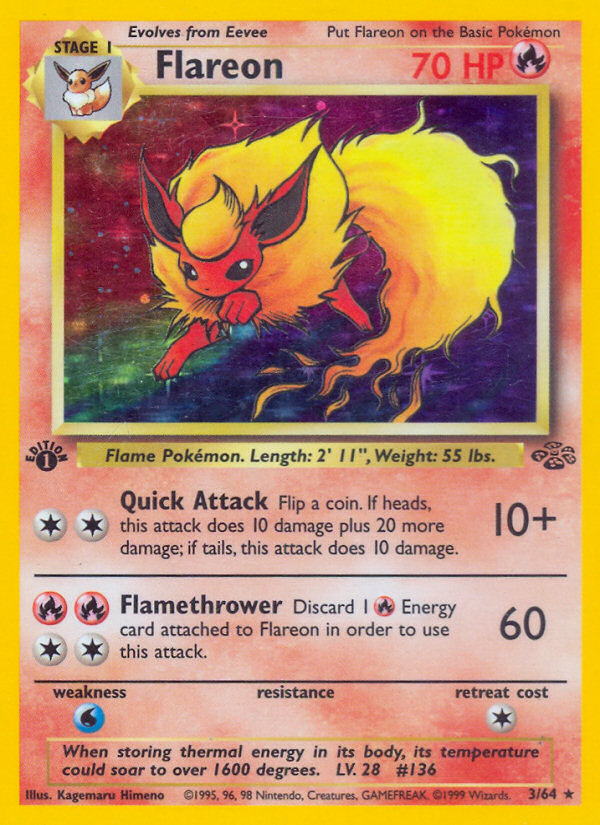
Pull a 1999 Jungle holo out of a binder and hold it under a lamp. The color is doing something modern cards mostly do not do. It sits in soft washes that bleed into each other, edges feathering where two colors meet, and tiny pale flecks drift across the background like dust caught in a sunbeam. That is watercolor on paper, photographed. The pokemon card illustrator responsible for more of those Jungle cards than anyone else is Kagemaru Himeno, and almost thirty years later she is still painting them.
Who is Kagemaru Himeno
Bulbapedia's profile gives her birth date as July 24, 1972 in Kanagawa Prefecture and describes her as a writer and illustrator who has provided material for Pokemon since the early years of the franchise. Her career started outside the game: the same entry says she began drawing manga illustrations for RIBON Original, a Shueisha magazine, in 1994, and that from 1997 she worked on a run of Pokemon publications including the Pokemon Tales picture books and her own series, translated there as How I Became a Pokemon Card. She goes by the nickname Himemaru. Bulbapedia also notes she is one of the few illustrators who has kept producing card art continuously since the game began.
Her card work starts at Jungle, and it does not start quietly. Query the Pokemon TCG API for the Jungle set and filter by credit line: of the 64 cards in the English set, 23 are hers. That is more than Mitsuhiro Arita's 19 and more than Ken Sugimori's 17. Jungle is the set that gave Flareon, Jolteon and Vaporeon their first cards, and Himeno painted all three, in both the holo and the non holo printing, along with the Eevee they evolve from.
The catalog since then is enormous. Bulbapedia counts 636 cards, plus 58 more in Pokemon Trading Card Game Pocket. The Pokemon TCG API returns 657 for an exact artist search, which counts reprints and alternate prints the wiki treats differently. Either number puts her in the small group of illustrators whose work you have almost certainly owned without ever reading the credit line.
Her signature style
Bulbapedia describes her medium plainly: watercolors, bright and vivid colors, softer tones used to pick out light and shadow. What that means on a card is that nothing is sealed off with a hard outline the way a digital illustration is. Her linework is a brush line of varying weight, and the color inside it is layered rather than filled, so a Flareon's mane runs from deep orange at the root to pale yellow at the tip without a visible step between them.
The tell worth learning is the flecks. Bulbapedia notes she adds soft white specks to some images, which could read as cotton spores, and that these are most apparent on her older work. You can confirm it yourself with nothing but a magnifier. Zoom into the artwork window on Jungle Flareon and the maroon and purple field behind it is peppered with small blue and grey dots that are clearly painted, not print noise. Do the same on Dark Gyarados and the near black water is scattered with pale blue and lilac specks and two or three small six pointed snowflake shapes. Once you have seen them on two cards you start seeing them everywhere in the Neo and e Card years.
The third thing to watch is how her backgrounds changed. Bulbapedia's description of a sharper eye for detail and more adventurous backgrounds over time holds up against the catalog. The 1999 work puts the creature on an abstract wash of color. The 2026 work puts it in a real place, with reflected light, depth and props. Same hand, same softness, far more information.
Cards to know
Five cards, spread across 27 years, all credited on the printed card to Illus. Kagemaru Himeno.
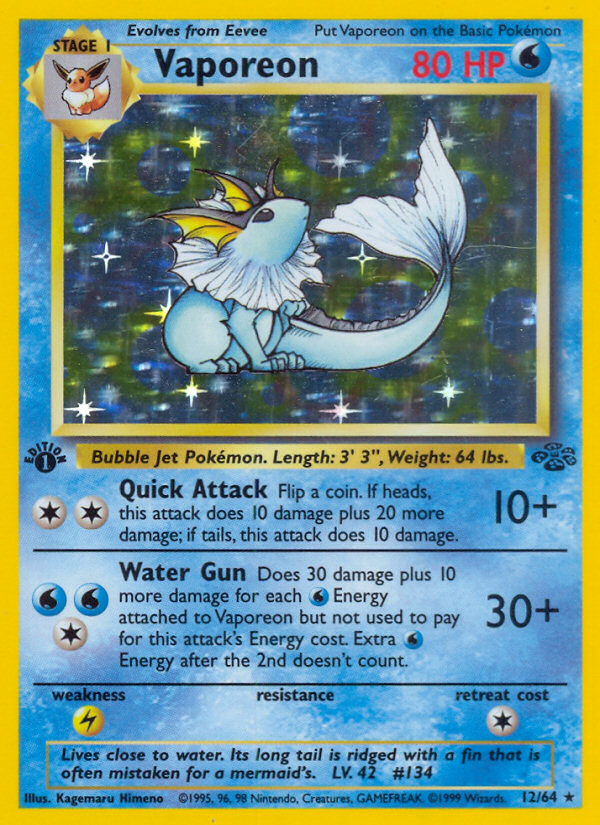
Vaporeon, Jungle 12/64. The companion piece to the Flareon above and the better lesson in her lighting. Vaporeon sits curled with its tail fanned out, painted in pale mint and cream, on a mottled blue green field with white four pointed sparkles floating through it. The whole card is built from cool tones, and the only warmth is the small yellow frill at the neck.
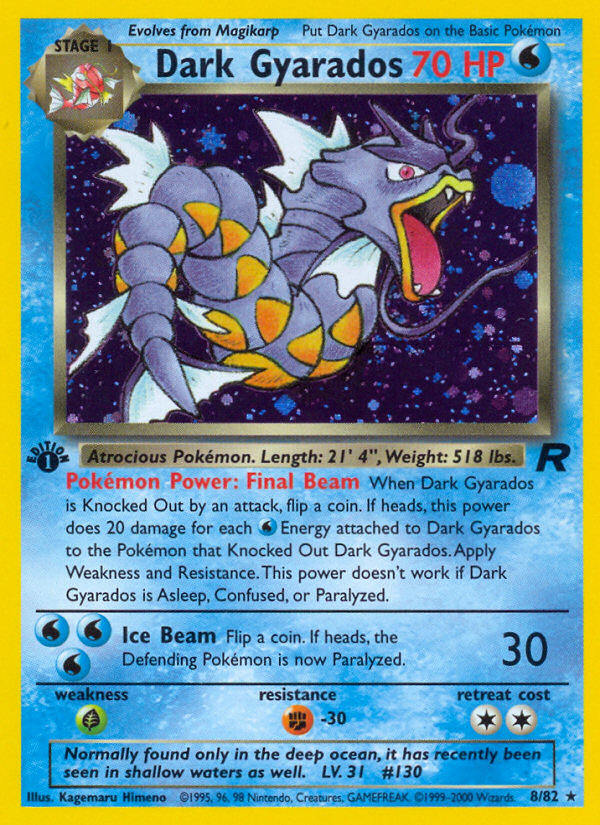
Dark Gyarados, Team Rocket 8/82. Proof that a watercolorist can do menace. The body is grey violet with hard yellow belly plates, the mouth is open on a red throat, and the background is almost black water flecked with blue. It was reprinted in the Celebrations Classic Collection in 2021, which is how a lot of newer collectors met it. Its Magikarp side of the family shows up again in our Magikarp illustration rare breakdown.
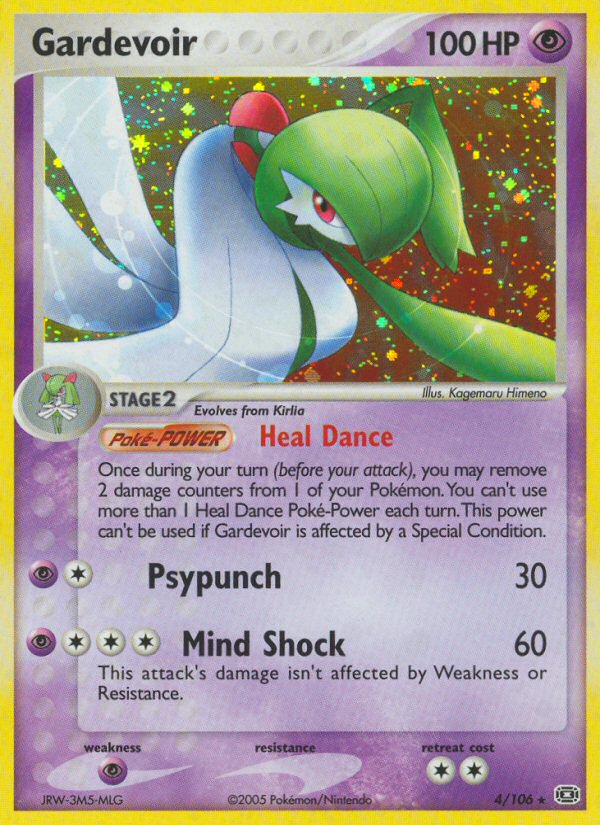
Gardevoir, EX Emerald 4/106. The midpoint of her career and the most elegant thing in this list. Gardevoir turns away from the viewer with the white gown sweeping across the frame in one continuous wash, green hair reading almost as leaves, against a dark red ground that makes the pale figure glow.
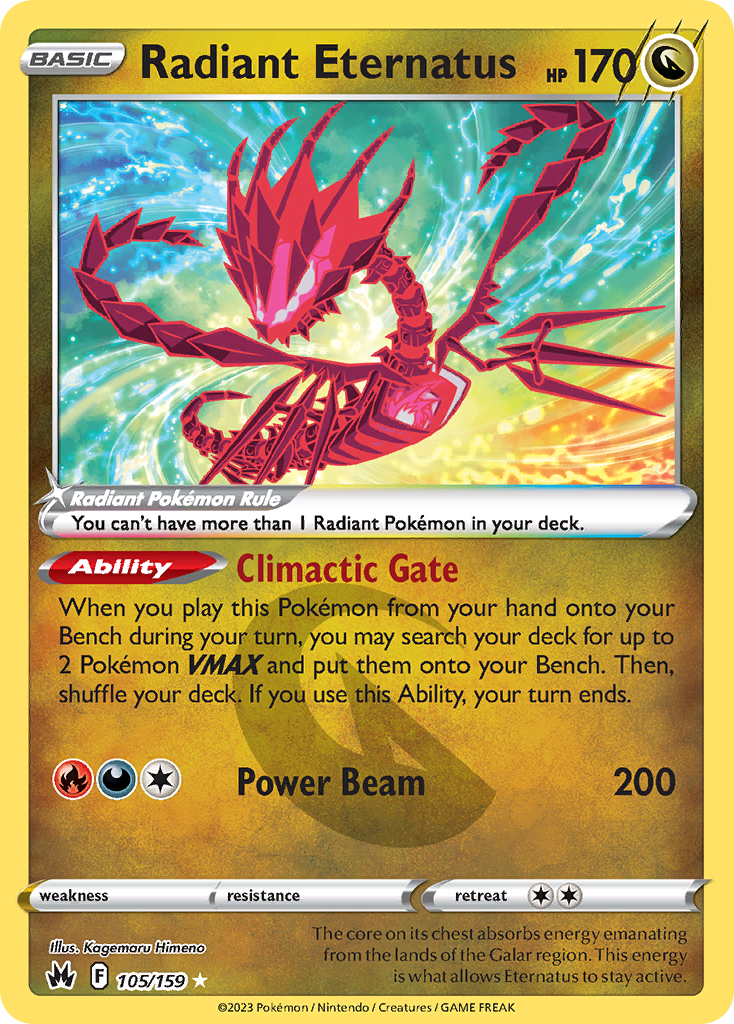
Radiant Eternatus, Crown Zenith 105/159. The card that shows she adapted rather than retired. The crimson skeleton is painted with the same layered reds as ever, but it is set against a swirling band of cyan, gold and green that wraps the whole artwork window. Radiant Rares are one per deck by rule, so this is a card plenty of players own without noticing the credit.
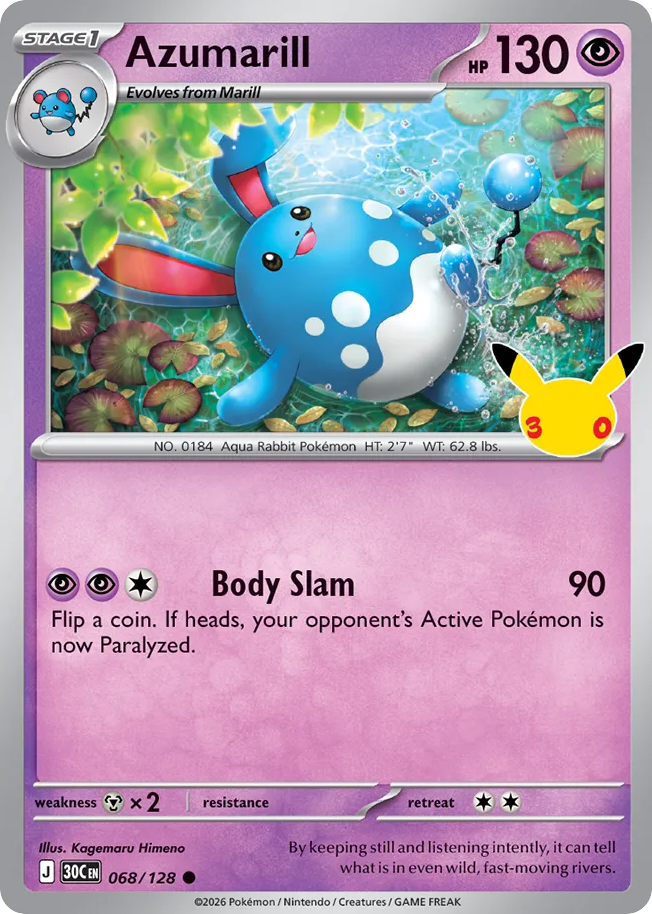
Azumarill, 30th Celebration 068/128. Printed in 2026 and still unmistakably her. Azumarill floats in clear water with sunlight breaking on the surface above it, lily pads and reeds crowding the frame, a single bubble rising off the ear. Look at what the background is doing compared to the flat wash behind the 1999 Flareon and you can see the whole arc of a career in two cards.
Build a Kagemaru Himeno binder page
Most artist pages are built from expensive modern chase cards. Hers is the rare one you can build from the bargain box, because her catalog is mostly commons, uncommons and ordinary rares spread across every era of the game. A standard nine card page could run Jungle Flareon, Jolteon and Vaporeon across the top row, drop Eevee and two Team Rocket cards in the middle, and close with Gardevoir, Radiant Eternatus and the 2026 Azumarill. Three rows, three decades, one painter.
It also sorts unusually well, because watercolor gives you an even value range instead of the hard contrast a full art has. Nothing on the page shouts down its neighbors. If you want the page to read as a timeline, run it oldest to newest left to right and let the backgrounds get busier as the eye travels. If you want it to read as a painting, sort by temperature instead: Vaporeon's mint and Dark Gyarados's near black on one side, Flareon's orange and Gardevoir's red ground on the other. Our guide to organizing a Pokemon binder covers both approaches, and for the designer side of the Eevee story our Atsuko Nishida artist feature is the natural companion piece. Drag the layout together in Binder Builders first and you will know what you are hunting before you spend anything.
Himeno is the answer to a question most collectors solve incorrectly. Ask who painted the vintage cards and the reflex answer is Arita, because Arita painted the Charizard. But open Jungle and count the credit lines, and the set belongs to Himeno by a clear margin. Learn the feathered washes and the white flecks, and a set of cards you have flipped past for years turns into a body of work by one person who is, right now, still painting.