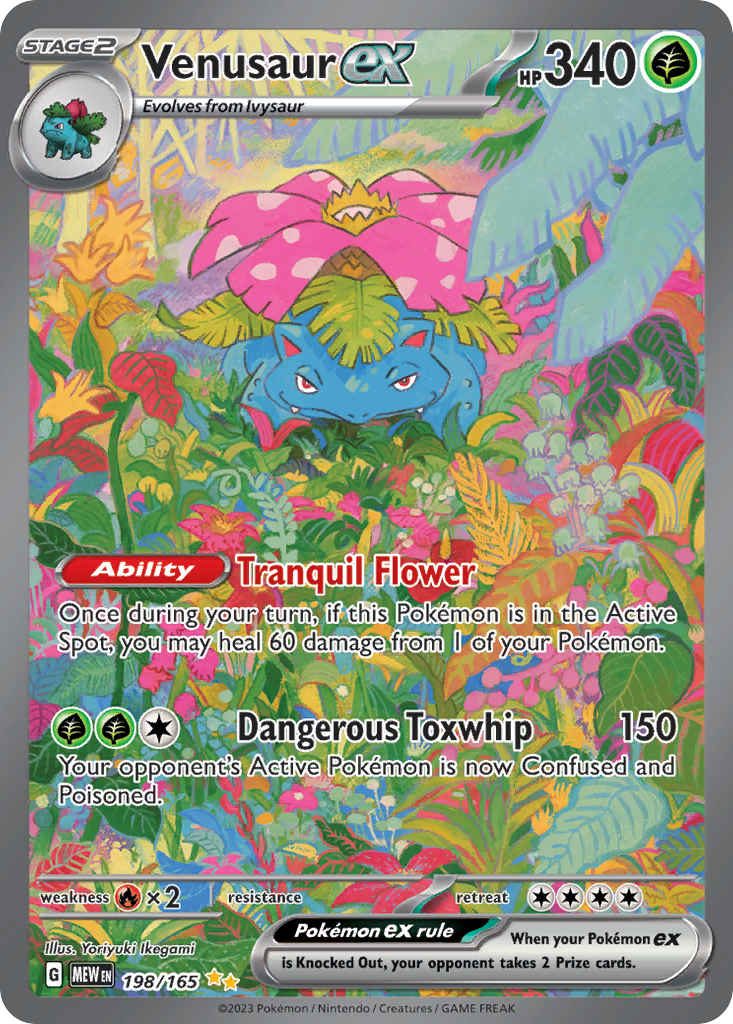
Some illustrators paint a Pokemon and put a background behind it. Yoriyuki Ikegami paints a garden and lets a Pokemon live in it. His cards are packed corner to corner with leaves, petals, lily pads and undergrowth, laid down in soft chalky color, and the creature is usually half buried in the middle of it. If you have ever pulled the 151 Venusaur ex and wondered which pokemon card artist made a 340 HP Venusaur look like a flowerbed, this is the one, and his catalog is one of the most cohesive artist binder pages in the modern game.
Who is Yoriyuki Ikegami
Yoriyuki Ikegami (Japanese: イケガミヨリユキ) is a Japanese illustrator. Per his Bulbapedia illustrator page, his first Pokemon Trading Card Game card was Gardenia's Vigor from the Crown Zenith Galarian Gallery in January 2023. Like a handful of other recent debuts, he did not start on a common. He started on a full art Supporter.
The better story sits two years earlier. The March 2021 issue of the Japanese magazine Illustration ran a long Pokemon Card Game feature, and PocketMonsters.net's contents listing for that issue records a section it calls a dream project, in which seven illustrators each drew the Pokemon they wanted to illustrate. Ikegami is named in that group of seven, alongside Amelicart, Ayako Ishiguro, Misaki Kihara, Yoko Kuno, Gemi and Keiji Yano. So a magazine asked him to imagine a Pokemon card roughly two years before the card game itself put his name on one.
The official Pokemon site noticed the same thing everyone else did once he arrived. Its 2023 artist debut roundup opens his entry by asking whether you have ever seen an artist with "a green thumb", then credits him with consistently building floral settings around the Pokemon that live in them, and points out an Ivysaur in the Gardenia card whose bulb nearly disappears into the surrounding flowers.
That is not a vague impression. A live artist query against the Pokemon TCG API returns 20 English cards credited to him, running from Crown Zenith to a Volbeat in 30th Celebration dated September 2026. Fourteen of those 20 are Grass types. His first card belongs to the Grass-type Gym Leader of Sinnoh, and his Ascended Heroes common is Erika's Oddish, which belongs to the Grass-type Gym Leader of Kanto. The Pokemon Company has effectively made him the house botanist.
His signature style
Three things make an Ikegami readable from across a table.
The first is density. There is almost never empty space. Where another illustrator would fade a background into atmospheric haze, Ikegami keeps drawing: individual leaves, individual petals, stems crossing in front of other stems, lily pads stacked until they tile the lower third of the frame. Every layer stays in focus. The result reads less like a photograph with a shallow depth of field and more like a botanical print that someone let a Pokemon wander into.
The second is the surface. The color goes down dry and slightly powdery, with visible directional strokes, closer to colored pencil and gouache than to airbrush. Outlines are drawn in colored line rather than black, so nothing locks into hard contour. Up close you can see individual pencil marks in a single leaf.
The third is the camouflage. Ikegami composes so the Pokemon is partly hidden by its own habitat and shares the habitat's palette. The Bulbasaur below is a green and blue-green animal asleep inside a wall of green and blue-green foliage. Even on the Zacian, a Psychic-type legendary with a sword in its mouth, the forest behind it is doing more visual work than the Pokemon is. You have to look for his subjects, which is the opposite of how a chase card usually behaves, and it is exactly why these cards reward being displayed rather than sleeved away.
Cards to know
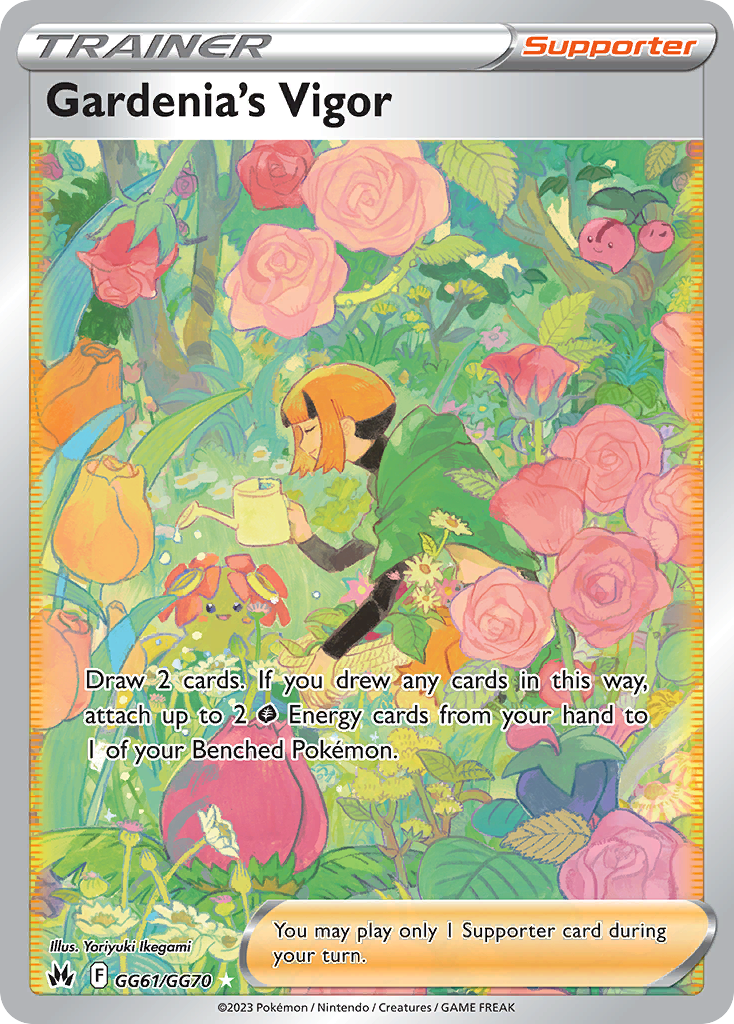
Gardenia's Vigor, Crown Zenith Galarian Gallery GG61/GG70. The debut, and still the thesis statement. Gardenia kneels with her eyes closed and a pale yellow watering can, almost swallowed by roses, tulips and daisies in pink, coral and cream. Crop into the undergrowth and there is a round Grass type grinning out of the leaves with only its face showing, which is the trick he has repeated ever since.
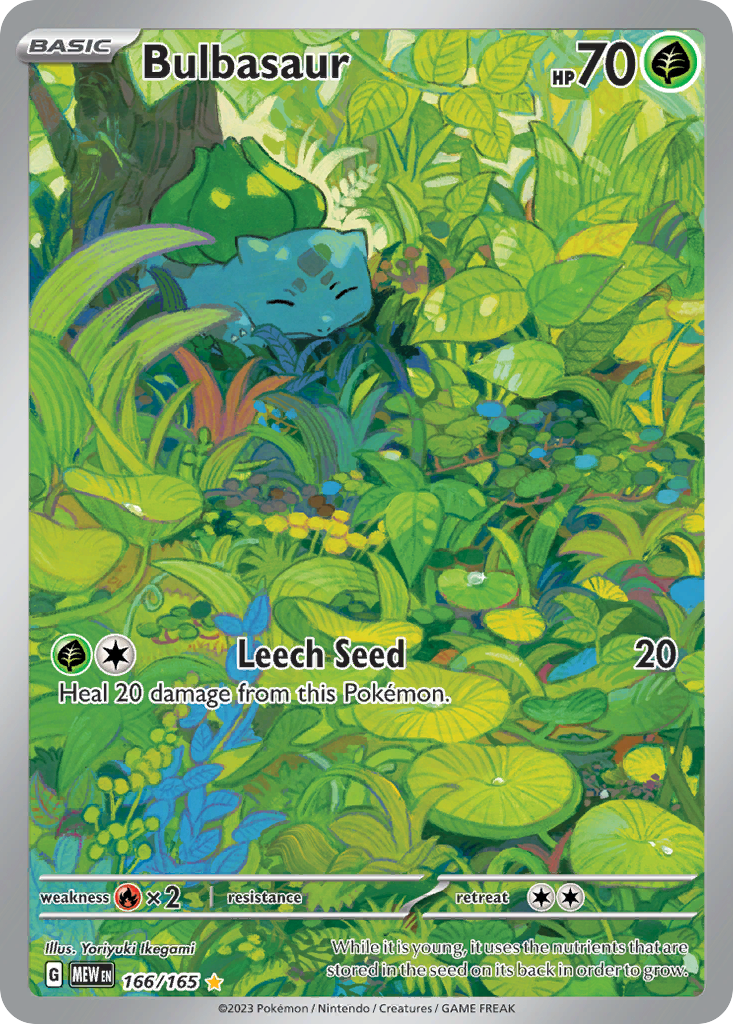
Bulbasaur, 151 166/165. An illustration rare where the subject is asleep. Bulbasaur is tucked into the upper left with its eyes shut, and the rest of the card is layered leaves running down to a pond edge of lily pads and small yellow water flowers. It is a quiet card in a set full of nostalgia bait.
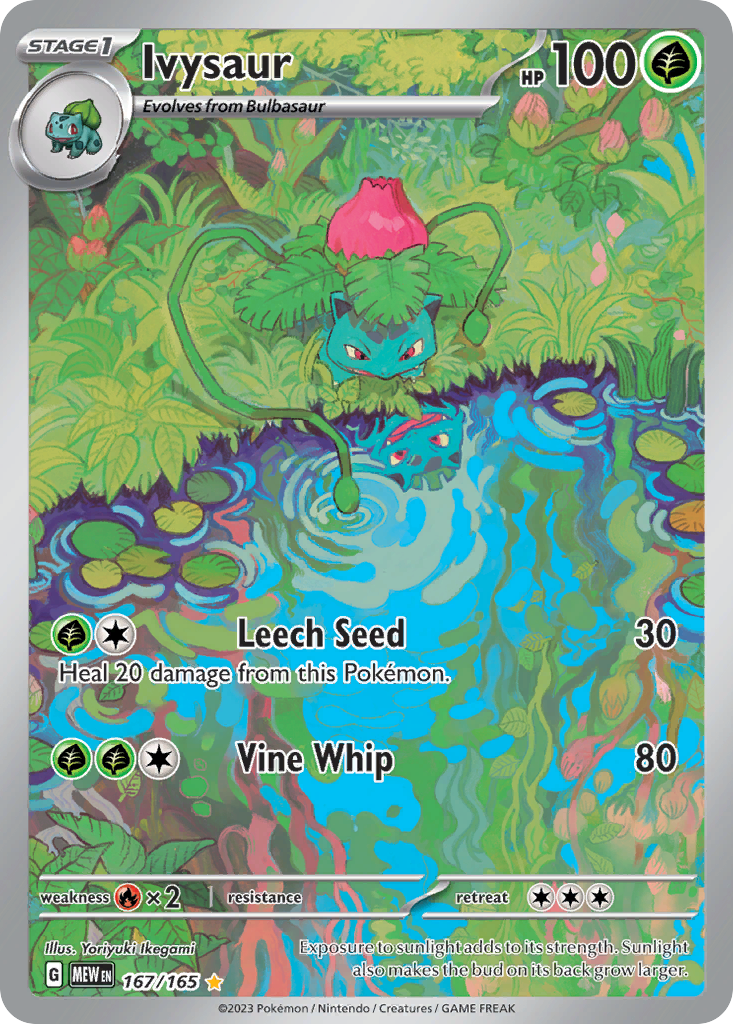
Ivysaur, 151 167/165. The same pond, one stage later. Ivysaur sits at the waterline with its vines trailing in, and the lower half of the card is its reflection broken into bands of blue and turquoise ripples. Put 166 and 167 side by side in a page and they read as one continuous shoreline, even though the art panels do not physically join.
Here is the part most people miss. In 151, the regular Bulbasaur and Ivysaur were drawn by Yuu Nishida, our very first artist feature, and the Double Rare Venusaur ex went to 5ban Graphics. Ikegami got all three of the set's illustration rare treatments for that line: Bulbasaur 166, Ivysaur 167, and the special illustration rare cover card. One artist was handed the entire Kanto starter evolution line at its highest rarity.
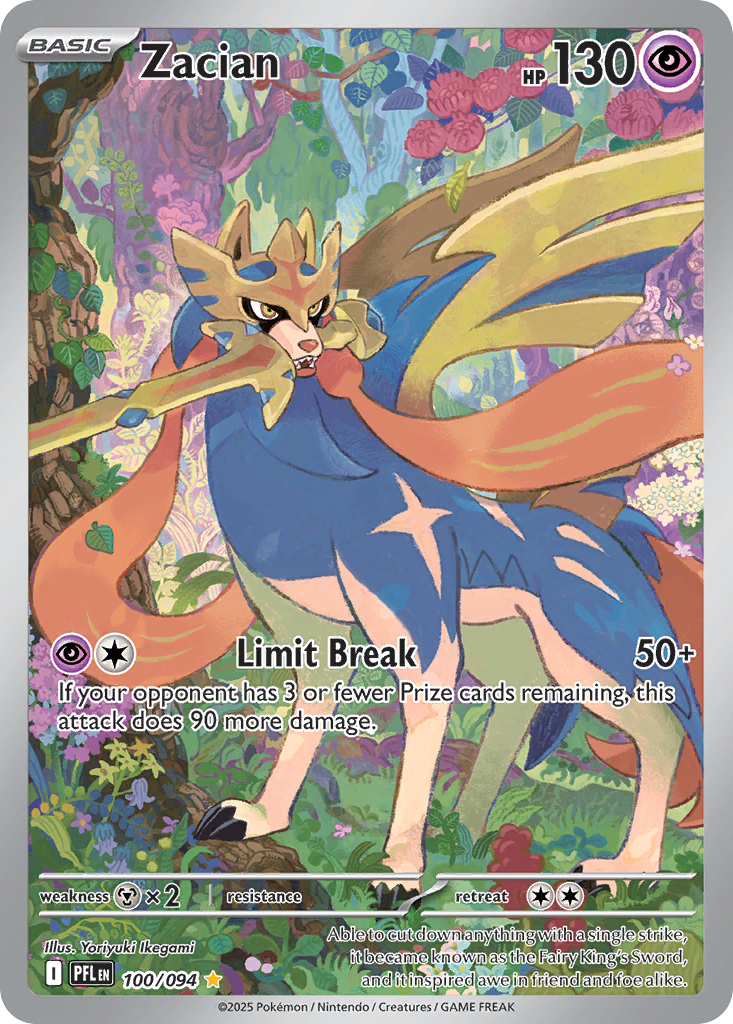
Zacian, Phantasmal Flames 100/094. Proof he does not only draw small cozy Pokemon. Zacian charges forward with a golden sword clamped in its mouth, blue and cream against a wall of flowering trees in pink, violet, mustard and mint. A lesser version of this card would have used a dark void background to make the legendary pop. He filled it with berries instead.
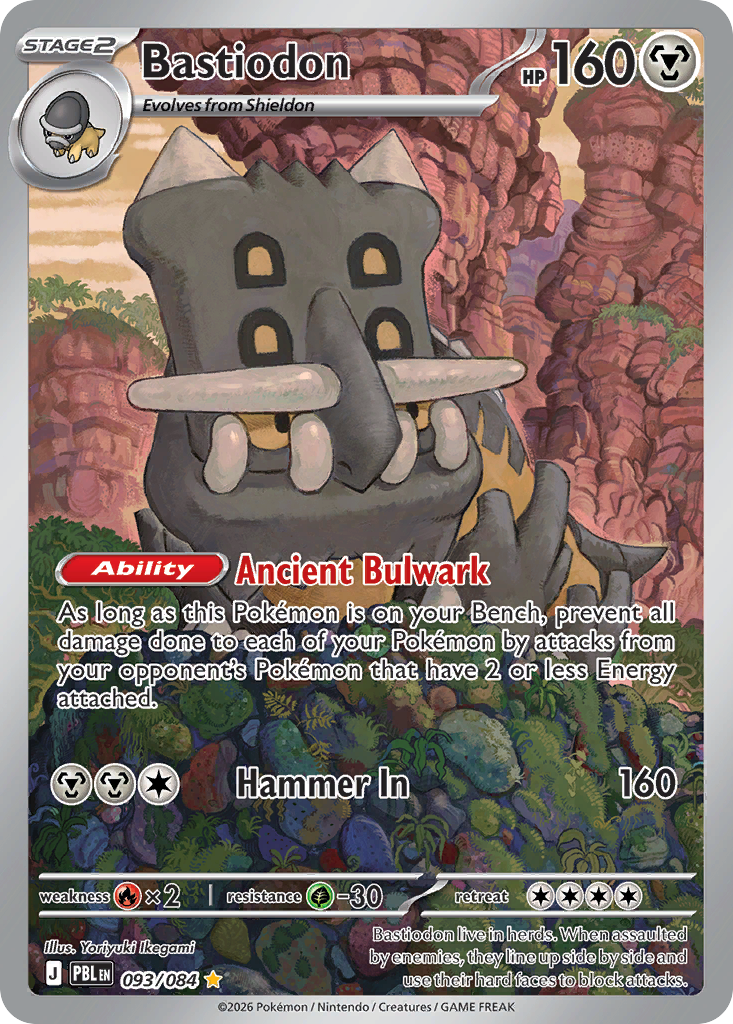
Bastiodon, Pitch Black 093/084. From July 2026, and the best test of the pattern. A Metal-type fossil in a red rock canyon is about as far from a flower meadow as the game gets, and he still filled the entire bottom third with mossy boulders, lichen and small succulents. The habit holds even when the brief fights it.
Build a Yoriyuki Ikegami binder page
Artist pages are at their best when the artist has a palette, and Ikegami has one of the most unified in the modern game. Greens, soft pinks, cream and water blue, at low saturation, on nearly every card. Nine of these in a nine pocket page do not just look related, they look like one picture cut into nine.
Build it as a landscape rather than a ranking. Put the Venusaur ex special illustration rare in the center, flank it with the Bulbasaur and Ivysaur illustration rares so the pond carries across the middle row, then fill the corners with the cheap Grass commons. Skiploom, Combee, Paras, Parasect, Shroomish, Tangela, Gloom, Budew and Erika's Oddish are all his, all in the same palette, and most cost less than a sleeve. The Gardenia full art belongs on the page too if you can find one at a price you like.
If you want the method behind artist grouping and color sorting before you commit a page to one illustrator, our guide to organizing Pokemon cards in a binder walks through both. And if you want a page that argues with this one, the Jerky feature is the exact opposite temperature: flat poster color and hard black outlines instead of soft layered botany. The two pages facing each other is a genuinely good spread.
Learn this one by the background, not the Pokemon. Ikegami is the illustrator who decided the habitat deserved as much drawing as the creature, then kept that promise on a legendary wolf and a steel fossil. Open the builder and give him a page.