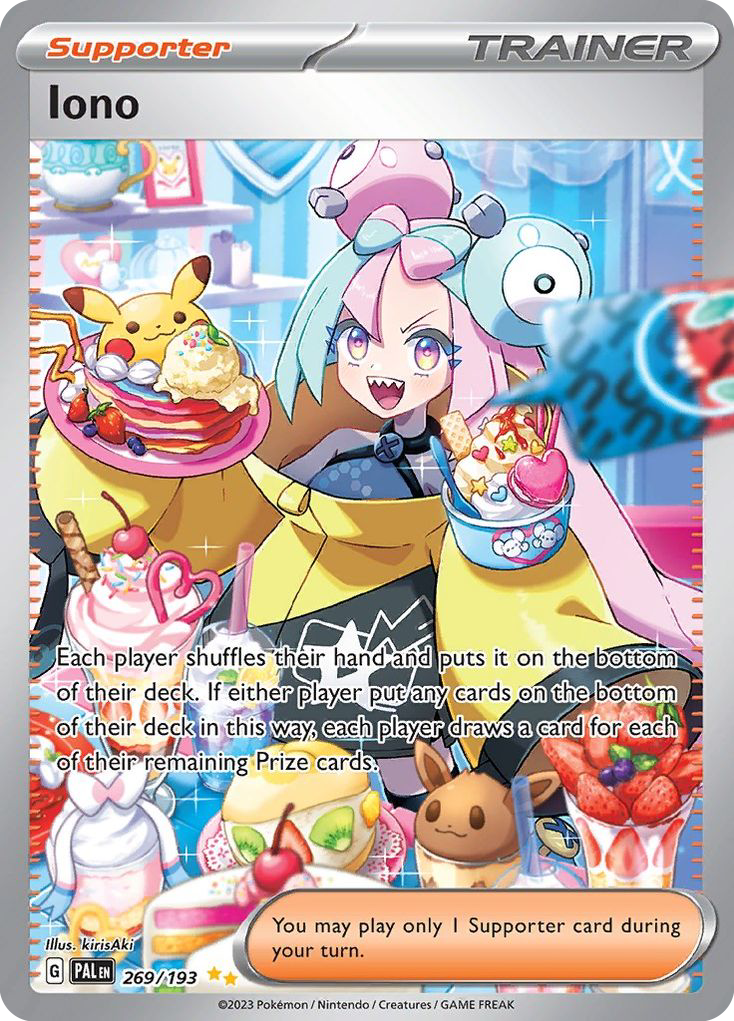
There is a specific kind of Pokemon card that stops a binder page cold. No Pokemon in the frame, or barely one. Just a person, drawn with so much confidence that the character reads instantly across the room. Iono. Marnie. Rosa. Irida. Four different sets, four different eras, one pokemon card artist. Her name is kirisAki, and if you collect trainers at all, she is already the most represented illustrator in your binder.
Who is kirisAki
kirisAki is a Japanese illustrator whose Pokemon TCG work started deep in the Black and White era. Bulbapedia's illustrator page records her first card as Tangela from Legendary Treasures, released in 2013, and lists her birthday as February 5. It credits her with 159 cards in the standard TCG plus another 27 in Pokemon Trading Card Game Pocket. A live artist search on the Pokemon TCG API returns 190 English cards, which is the same catalog counted with reprints and alternate rarities folded in.
She did not stay inside the card game. Bulbapedia's profile also lists her as a key artist on Pokemon Masters EX and credits her with Holowear cosmetic designs in Pokemon UNITE, including outfits for Charizard, Gardevoir and Greninja. That matters for reading her cards, because character design work and card illustration reward the same skill: making a person legible and appealing in one pose.
The turning point was Cosmic Eclipse in 2019. Bleeding Cool's artist spotlight on kirisAki notes that her Rosa became the chase card of that set, which is remarkable given the competition it was up against in a set full of alternate arts and a Rainbow Rare Charizard. Collectors noticed. From there the run barely paused: Marnie in Sword and Shield base, Skyla in Shining Fates, Raihan in Evolving Skies, Irida in Astral Radiance, then Iono in Paldea Evolved, a card that spent most of 2023 as the most talked about trainer in the game.
Her signature style
Bleeding Cool describes the split cleanly: sharp and confident linework on her Full Art Trainers, and a softer, more painterly touch on her Pokemon. Once you know to look for it, that contrast is the fastest way to identify her.
Start with the line. Her trainers have real anime cel weight to them, clean outlines, flat confident color, glossy hair rendered in three or four values instead of twenty. She is not chasing photorealism. She is chasing the feeling of the character, and she wins by leaving things out.
Then look at the eyes and the hands. kirisAki draws faces that hold a specific mood rather than a generic smile. Marnie is flat and unimpressed. Volo has a smile that you should not trust. Irida is warm and mid motion. She also poses hands properly, which sounds minor until you notice how many trainer cards hide them. A pointed finger, a Poke Ball balanced on a fingertip, a fist raised at the camera. That is her staging.
Last, look at the backgrounds. They are shallow and simple: a wall, a stand of trees, a pillar, a wash of light and sparkle. She keeps depth low on purpose so nothing competes with the character. The exception is her Pokemon work, where the brush loosens up completely and the setting takes over. Same artist, opposite dial setting.
Cards to know
Her catalog covers about thirteen years, so this handful skips across four eras of the game.
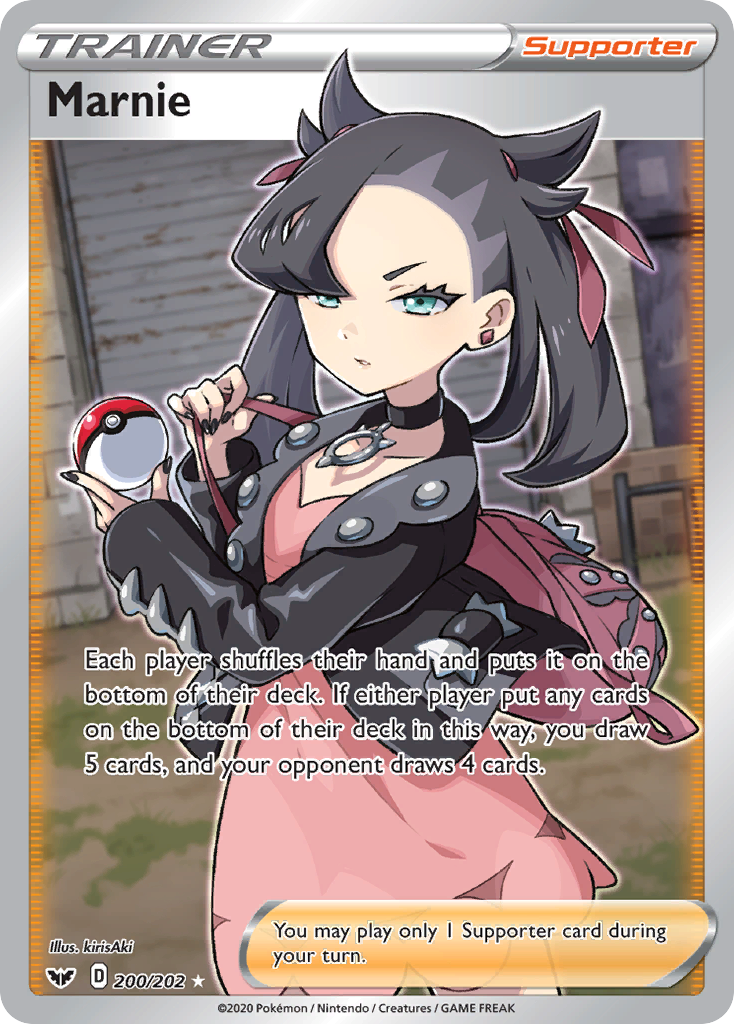
Marnie, Sword and Shield 200/202. The card that made a generation of collectors learn an illustrator's name. Marnie tilts a Poke Ball on her fingers against a plain concrete wall, gives the camera nothing, and somehow carries the whole card. It is the purest example of kirisAki doing more with less.
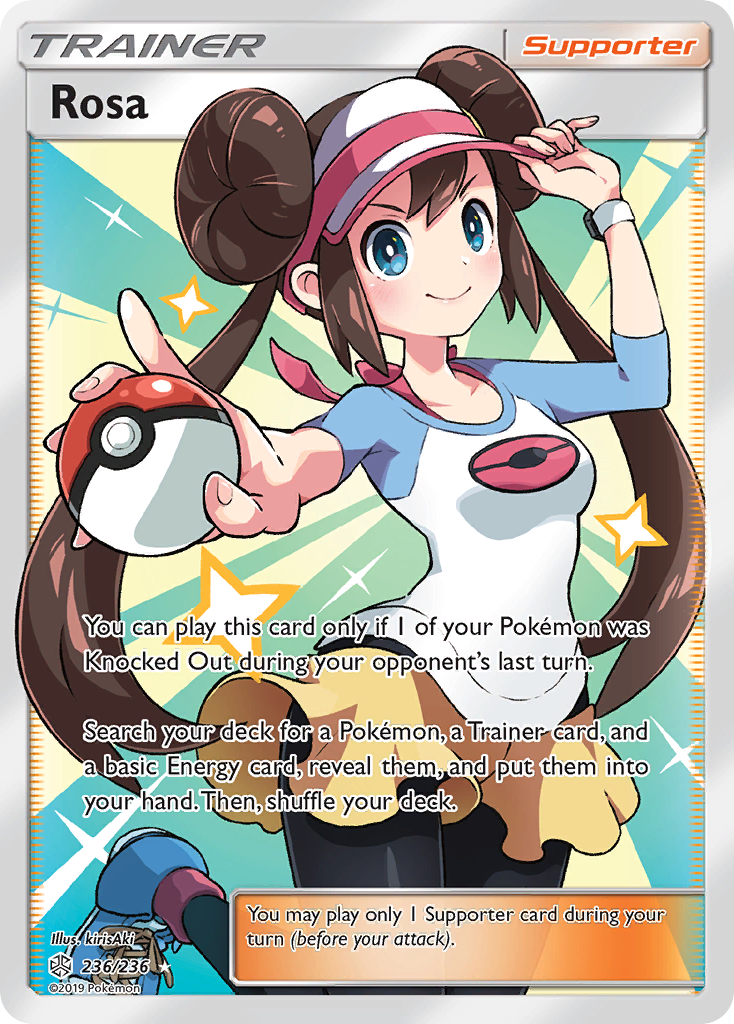
Rosa, Cosmic Eclipse 236/236. The breakout. Rosa tips her visor with one hand and offers a Poke Ball with the other, framed by pale mint and yellow rays and hand drawn sparkles. It is pure energy, and it beat an entire set of alternate arts to become the card everyone wanted.
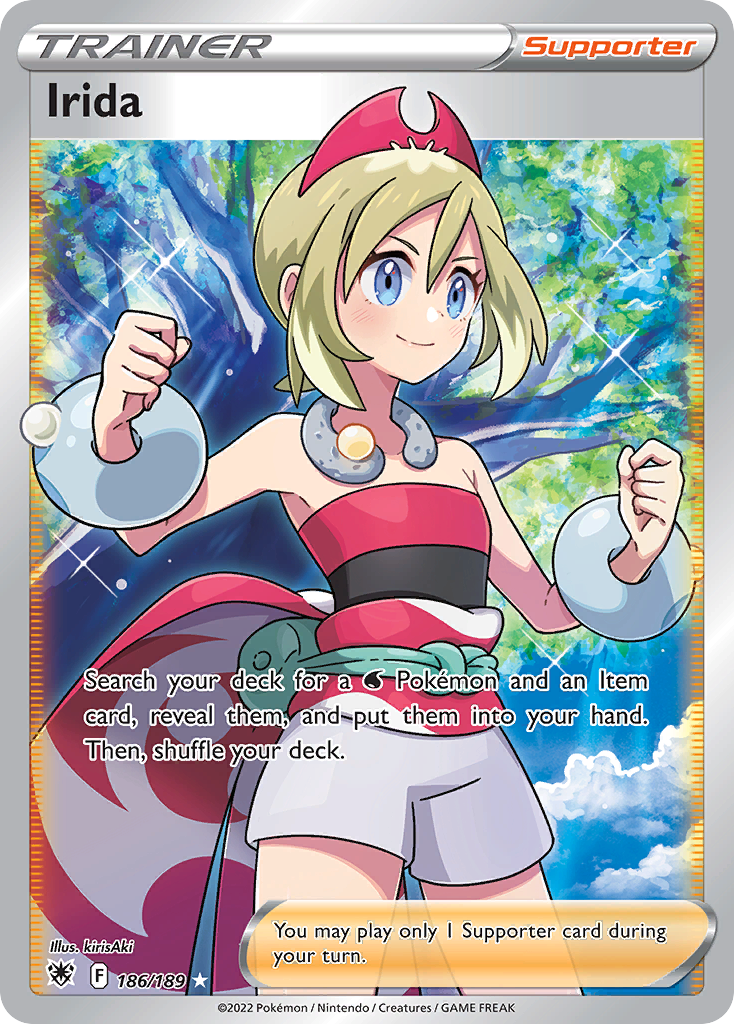
Irida, Astral Radiance 186/189. Here she lets the background breathe. Irida stands mid stride in front of a Hisuian forest painted in loose blue and green strokes, snow light on the left, blue sky on the right. The soft brushwork behind the crisp character is her two modes on one card.
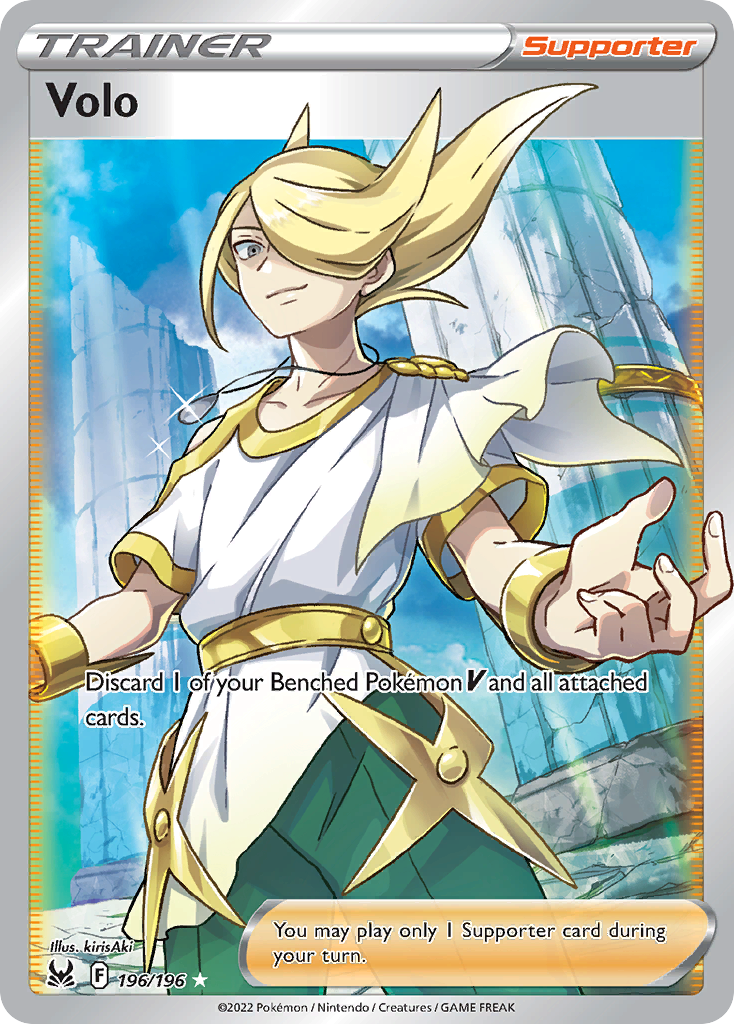
Volo, Lost Origin 196/196. Character acting as a full art. Volo reaches toward you against broken white pillars and open sky, all gold trim and windblown hair, wearing the friendliest untrustworthy expression in the game. Anyone who has finished Legends Arceus reads the whole plot in that face.
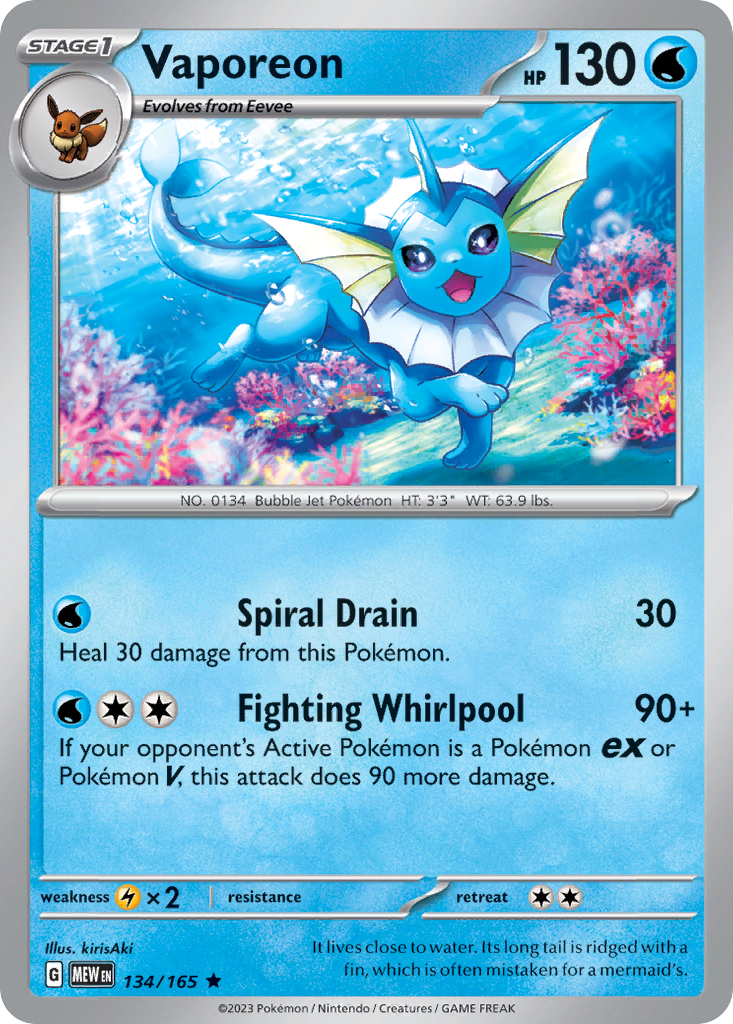
Vaporeon, 151 134/165. Proof of the other dial setting. No lines to speak of, just soft blue water, drifting bubbles and pink coral, with Vaporeon curling through the middle of it. This is an ordinary set rare that costs almost nothing, and it is one of the prettiest cards in 151.
Build a kirisAki binder page
Most artist pages need you to hunt across a decade of commons. A kirisAki page assembles itself, because her Full Art Trainers are already the cards people remember from each set.
The obvious build is a nine card wall of her trainers in release order: Rosa, Marnie, Piers, Oleana, Skyla, Raihan, Irida, Volo, Iono. Nine slots, nine sets, one continuous style, and you can watch her line work tighten from left to right. It reads as a timeline rather than a pile.
The better looking build sorts by color instead. Her characters are strongly coded, so a page grouped by palette snaps together: the pink and cyan row of Iono and Rosa, the black and grey row of Marnie and Piers, the white and gold row of Volo and Irida. Because she keeps backgrounds shallow, the sleeves do not fight each other the way busy Pokemon scenes do. Our guide to organizing Pokemon cards walks through artist grouping and color sorting if you want the layout rules before you commit.
If the full art prices are out of reach, build the page from her regular rares instead. The Vaporeon above, her Professor's Research printings, her Obsidian Flames commons and her Scarlet and Violet uncommons: all cheap, all hers, and the painterly Pokemon cards make a softer page than the trainers do. Lay either version out in Binder Builders first, swap the anchor card around, and see which arrangement holds together before you buy a single sleeve.
kirisAki is the answer to a question collectors ask constantly without meaning to, which is why so many chase cards happen to be trainers. She figured out early that a person drawn with total conviction beats a Pokemon drawn with hesitation, and she has been proving it once a set ever since. For the illustrator who took Iono in the completely opposite direction, glowing and soft and full of scenery, read our Yuu Nishida artist feature. For the other end of the timeline, our Atsuko Nishida feature covers the artist who drew Pikachu in the first place.