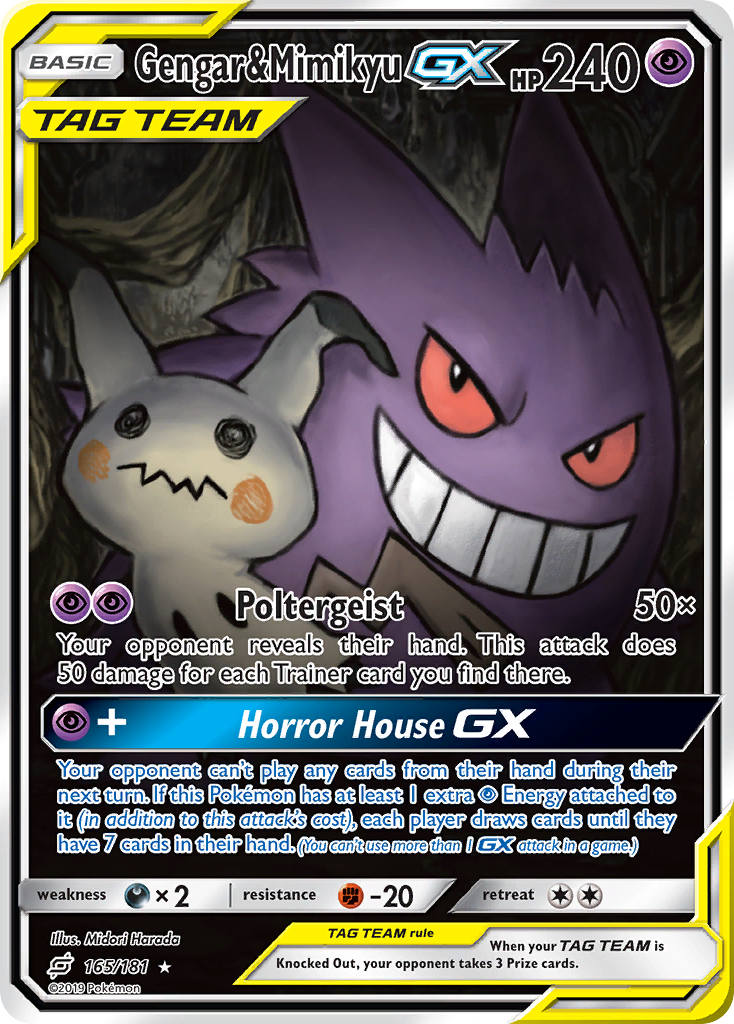
There is a particular kind of Pokemon card where the creature is almost incidental. You look past it, at the hills behind, at the light coming through the trees, at the water in the middle distance, and you realize somebody painted a whole place and then put a Pokemon in front of it. For about twenty years, the pokemon card illustrator doing that most often was Midori Harada, and if you played the games in the 2000s you have been looking at her work without knowing it.
Who is Midori Harada
Harada (Japanese: 原田みどり) has worked on Pokemon materials since 1996, according to her Bulbapedia profile, but she came to the trading card game late. Her first credits are three commons in Aquapolis, released January 2003: Cubone, Eevee and Houndour. The Pokemon TCG API confirms all three, and Cubone is a nice first card to have drawn, because Bulbapedia also records that Cubone is her favorite Pokemon.
What she was doing before the cards is the part most collectors miss. In an interview with PocketMonsters.net and its French affiliate PokemonEspace, recorded during a visit to Strasbourg, France, Harada described her job as conceptual art for the video games, specifically the region maps, alongside the card illustrations. The same interview credits her with the official maps for Hoenn, Sinnoh, the Generation III and IV Battle Frontier areas, and the redrawn Kanto and Johto maps that shipped in the guidebooks. She also told the interviewers she worked with Game Freak's director on the Distortion World in Platinum, and that the two of them did a lot of research into space sciences to get there.
Asked how far her involvement went, she gave an answer that turns out to describe her card work just as well as her game work: "I only worked on landscapes and maps."
She was not a player. She told the same interviewers she did not really have time for the TCG, though she liked the concept. At the time of that conversation she put her own count at more than 250 cards. Querying the API for artist:"Midori Harada" today returns 353 English cards across 314 distinct names, running from Aquapolis in 2003 to a Pineco in Temporal Forces in March 2024.
Her signature style
Bulbapedia gives her style a name, Aire Verte, and describes it as calm European landscapes. That is accurate but it undersells how you actually spot her, so here is the practical tell.
Harada paints weather and time of day. Other illustrators give you a backdrop. She gives you four in the afternoon. The Cubone below is standing in a full sunset, the sky banded orange into violet, mountains reduced to silhouettes across the water. The Cramorant is in a forest at the hour when the sun comes in sideways and turns the river white. The Lucario is in a storm. None of these are decorations behind the subject, they are the reason the card exists, and the Pokemon is frequently the least interesting shape in the frame.
The second tell is structural, and the catalog proves it outright. Harada has 353 cards and exactly seven of them are Trainers. All seven are Stadiums: Apricorn Forest and Undersea Ruins in Aquapolis, Ancient Ruins, Mirage Stadium and Underground Lake in Skyridge, then Battle Frontier twice. Not one Item, not one Supporter. A Stadium is the only Trainer card whose art is required to be a location, and across two decades those are the only Trainer assignments she got. The art direction had her figured out.
The third thing worth knowing is about rarity, and it changes what a Harada page costs. Of her 353 cards, 256 are Common or Uncommon, roughly 72 percent. She has 32 Rare Holos and precisely one Rare Ultra in the whole English run. Compare that to the Masakazu Fukuda feature, where one illustrator owns an entire premium rarity, and the two careers look like opposites. Fukuda got the chase slot. Harada got the commons, which is to say she got the cards everyone actually opened.
Cards to know
Five from the catalog, every one checked against the printed Illus. line on the card.
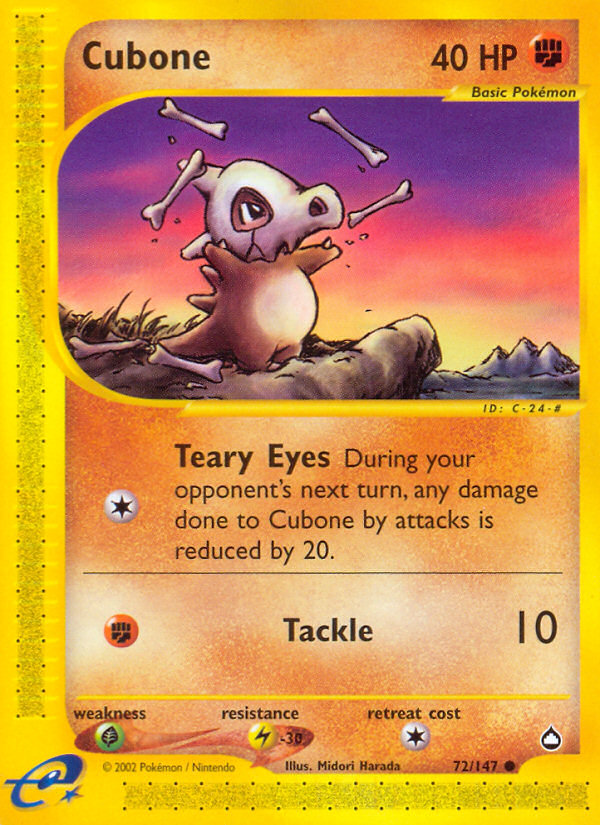
Cubone, Aquapolis 72/147. One of her three debut cards and a thesis statement in a common slot. Cubone is mid tantrum with bones flying, but the card is really a sunset: layered orange, pink and violet sky, a dark headland, still water, distant peaks. Nothing about a 40 HP common required this much landscape.
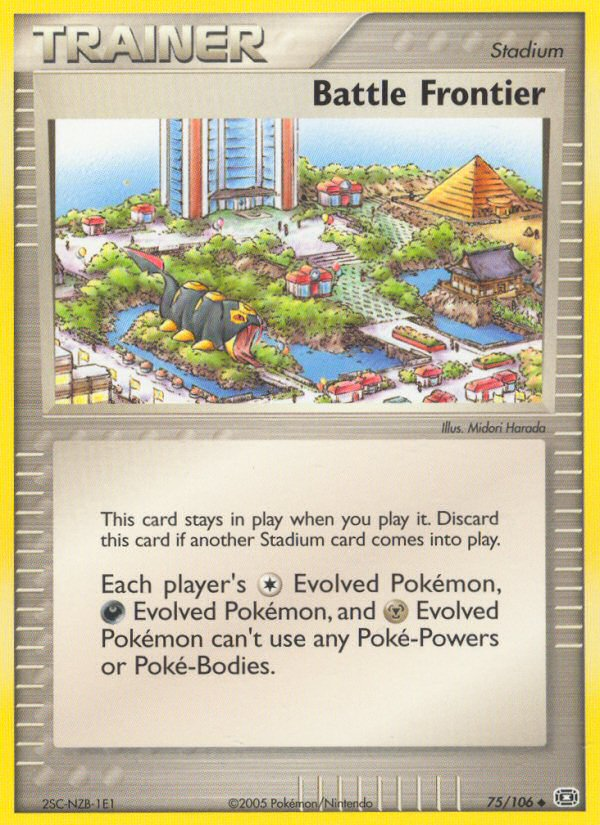
Battle Frontier, EX Emerald 75/106. The clearest bridge between her two jobs. This is a Stadium card drawn as an aerial map, the Battle Tower and the pyramid and the Battle Dome laid out across islands and waterways in the same elevated three quarter view she used for the guidebook regions. There are no Pokemon in it at all. It is a place, rendered by the person who drew the places.
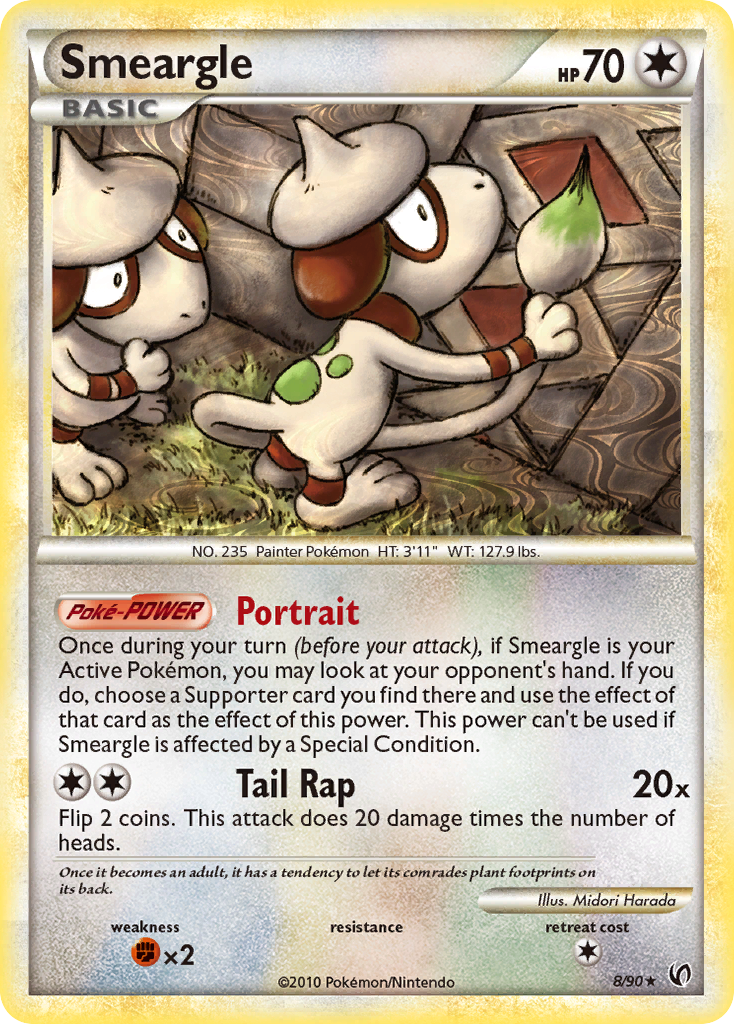
Smeargle, HS Undaunted 8/90. The Painter Pokemon, handed to a painter. Two Smeargle work a green stroke onto a weathered stone wall that already carries older marks, with grass at the base and the carved panels going back into shadow. The card's own Poke-Power is called Portrait. Harada drew Smeargle again for Call of Legends the following year.
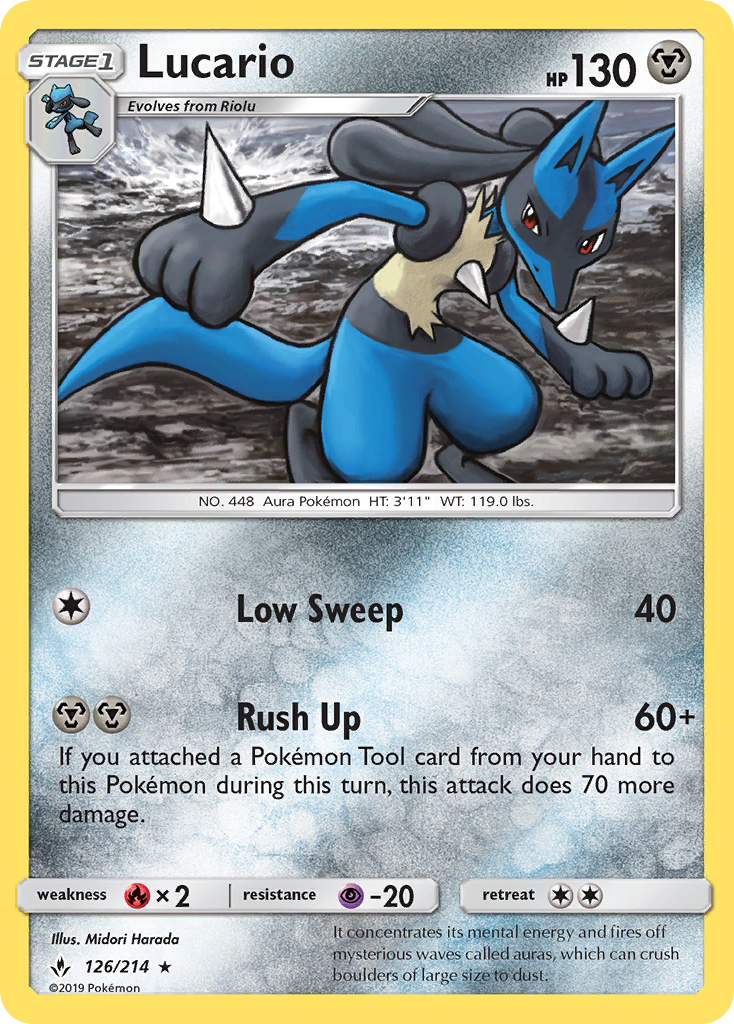
Lucario, Unbroken Bonds 126/214. Her range check. Here the landscape is reduced to grey rock and a sky full of blown cloud, almost monochrome, with Lucario's blue the only saturated thing on the card. She can do atmosphere without doing scenery, and it still reads as weather rather than a backdrop.
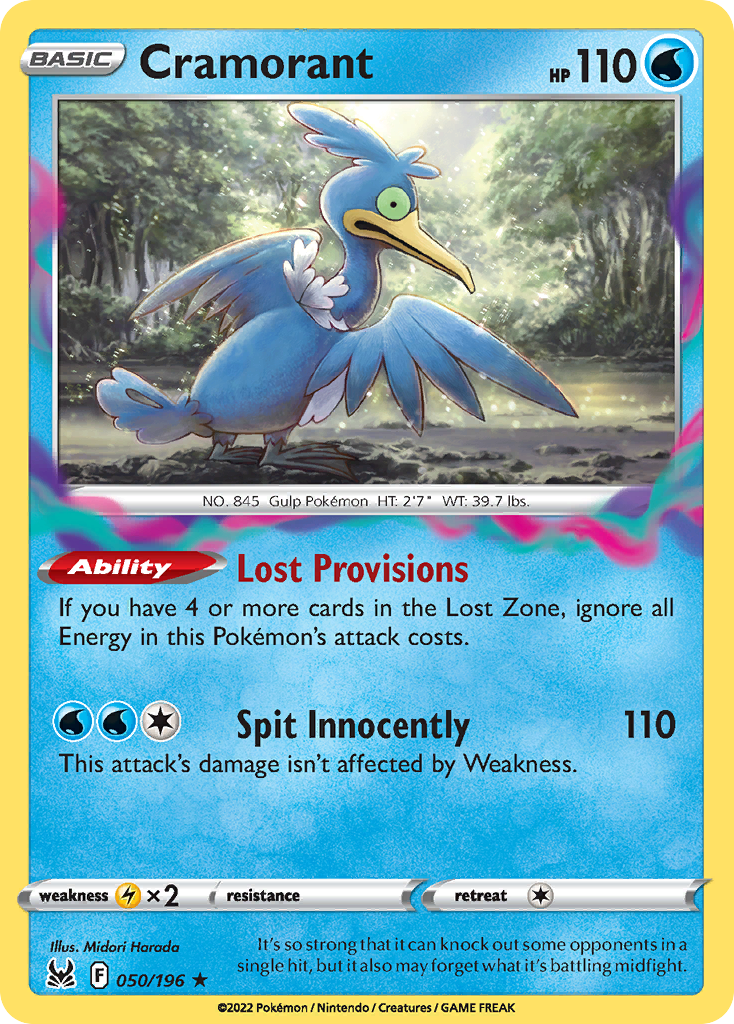
Cramorant, Lost Origin 050/196. One of her last cards and one of her best. Sun through a forest canopy onto a shallow river, dust and spray caught in the light, Cramorant shaking itself off on the stones. Twenty years after the Cubone and the instinct has not changed at all.
Build a Midori Harada binder page
This is one of the most achievable artist pages in the hobby, and the reason is the rarity split above. Nearly three quarters of her catalog is bulk rarity from the e-Card and EX eras, which means a nine pocket page of genuinely beautiful Harada art can be assembled for the price of a few singles rather than the price of a car. If you have ever wanted to finish an artist page instead of admiring one, start here.
Her work also happens to be unusually easy to lay out, because the backgrounds do the arranging for you. Sort by palette rather than by set. A sunset row of warm oranges and violets, a forest row of greens, a water or storm row of greys and blues, and the page reads as one continuous landscape across all nine pockets. Very few illustrators give you that, because very few of them commit to a full environment on a common. Our guide to organizing Pokemon cards in a binder walks through when color sorting beats set order, and a Harada page is the clearest argument for it.
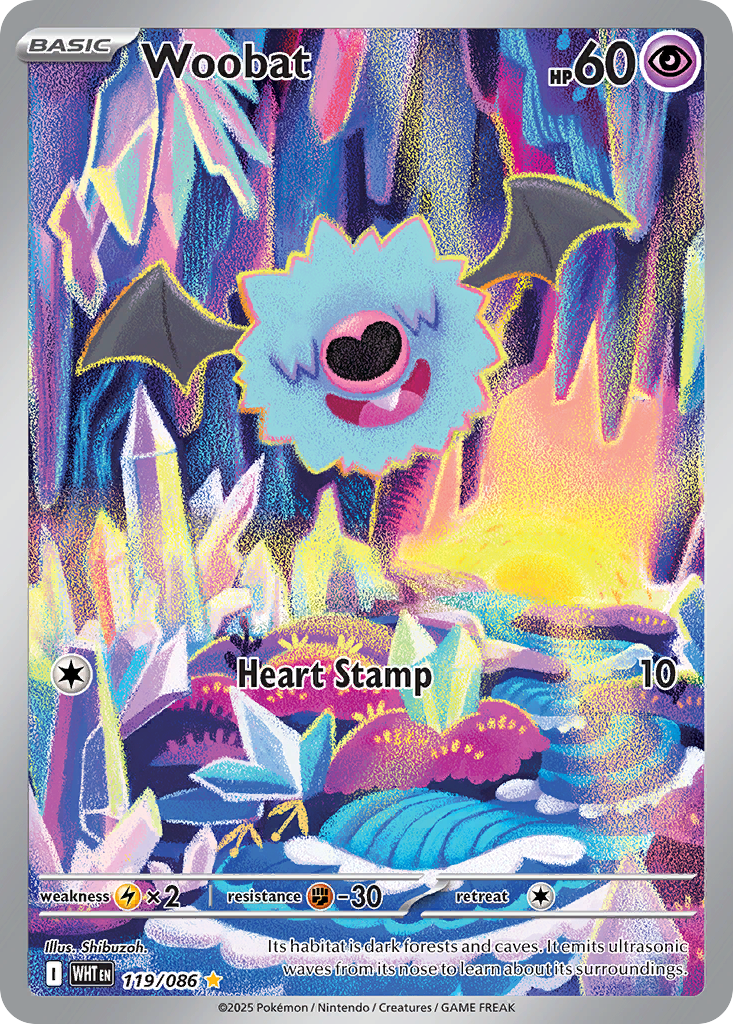
For the collector who wants a harder target, there is the Stadium run. Seven cards, all location art, all of them drawn by her. That fills most of a page on its own and it is the only complete thematic set hiding inside her catalog. Put the two Battle Frontier printings side by side and the guidebook connection is impossible to miss. If you prefer the environment-first approach in general, the Shibuzoh. feature is the modern counterpart to what Harada was doing in 2003.
Most artist pages are built around chase cards, which is why most of them stay empty. Harada's is built around the cards that came out of the pack four at a time and got sleeved and forgotten. Pull a stack of e-Card and EX era commons out of your bulk, check the Illus. line, and you will probably find you already own two or three of these. That is the whole appeal: the artist who painted the maps of Hoenn and Sinnoh also painted a sunset on the back of a 40 HP Cubone, and nobody told you.