Three cards in Paldea Evolved are set in the same bathroom. Same patterned ceiling, same little hanging lamp, same green cabinet above the mirror. A Quaxly is standing on the counter in the first one. By the third, a Quaquaval is filling the entire doorway. Nobody moved the camera. That is Souichirou Gunjima, the pokemon card artist who treats a set as a place rather than a series of posters, and once you notice the room you cannot unsee it.
Who is Souichirou Gunjima
Gunjima is a freelance illustrator, and his Bulbapedia illustrator page records a career that started outside the official pipeline. Before he ever drew for the TCG professionally, he entered the Pokemon Card Game Illustration Grand Prix as a contestant, submitting an illustration of Metagross. Bulbapedia also lists him as a guest illustrator on the Nintendo 3DS game Summons Board in 2014, and as the artist behind the Fire Stacking Tin merchandise featuring Charizard, Scorbunny, Braixen and Victini.
His first official card was Indeedee in Shining Fates, which the Pokemon TCG API dates to February 2021. That makes him a genuinely recent arrival, and the catalog has grown fast: an artist search on the API returns 88 English cards credited to him as of this week.
Here is the story that makes him worth knowing. Bulbapedia records that Gunjima's favorite Pokemon is Kabutops, and cites a tweet he posted on October 20, 2021 saying that one of his dreams was to draw an official Kabutops illustration. In 2023, the 151 set shipped with a Kabutops card, and Gunjima illustrated it. He posted again when it happened. Most illustrator trivia is a list of credits. This one is a person publicly wanting something, waiting about two years, and then getting handed the exact assignment.
His signature style
The clearest way to spot a Gunjima is to look past the Pokemon at what is behind it.
He builds rooms. Not backdrops, rooms, with a floor and a ceiling and objects that belong to somebody. His domestic cards are crowded with bottles, cans, toothbrush cups, potted flowers and patterned tile, all of it rendered with the same care as the subject. Other illustrators put a wash of light behind a character. Gunjima puts a sink.
He also draws interior life through posture. A lot of card art solves expression by making the Pokemon smile at the viewer. Gunjima gives them a task and lets the face follow. His Quaxwell is not posing, it is concentrating on its own hair with a scowl that would be funny on a person. That gap between the seriousness of the effort and the smallness of the job is his best recurring joke.
His color splits cleanly in two, which is useful in a binder. The quiet cards run on cream, mint green, pale blue and warm afternoon light, and the contrast stays low. The action cards go the other way entirely, into saturated orange, hot pink, chrome and flame, with hard diagonal slashes of color cutting across the frame. Set his Quaxly next to his Revavroom ex and you would not guess the same hand made both, until you notice that both are packed edge to edge with real objects.
Last, he works comfortably in the classic framed layout as well as full art. His Kabutops is a standard illustration window with the old dex line under it, and it still reads as a Gunjima.
Cards to know
His catalog is only a few years deep, so this is close to a greatest hits run.
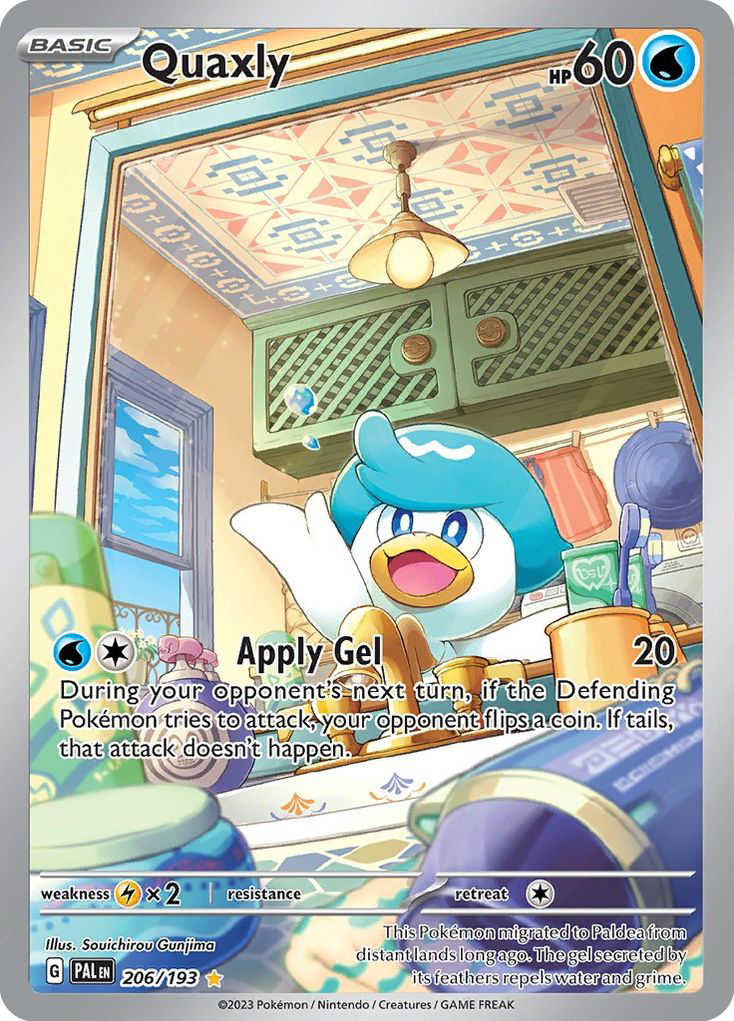
Quaxly, Paldea Evolved 206/193. The opening shot. A small Quaxly up on the bathroom counter with one wing raised and its beak open, surrounded by more bottles and jars than it could ever need, blue sky through the window behind it.
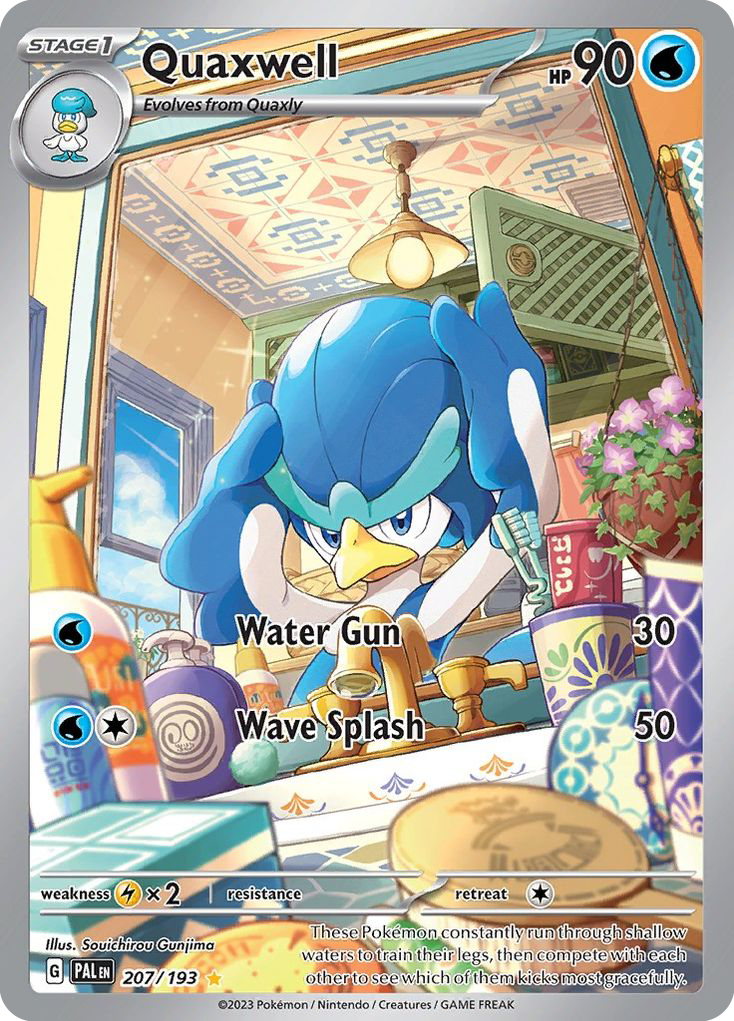
Quaxwell, Paldea Evolved 207/193. The middle panel and the funniest of the three. Bigger now, leaning over the running tap with a toothbrush in hand and a look of total grim focus. Bleeding Cool's write up of the Quaxly illustration rares reads the trio as a story about growing up, with the sink getting sorted out as the Pokemon matures.
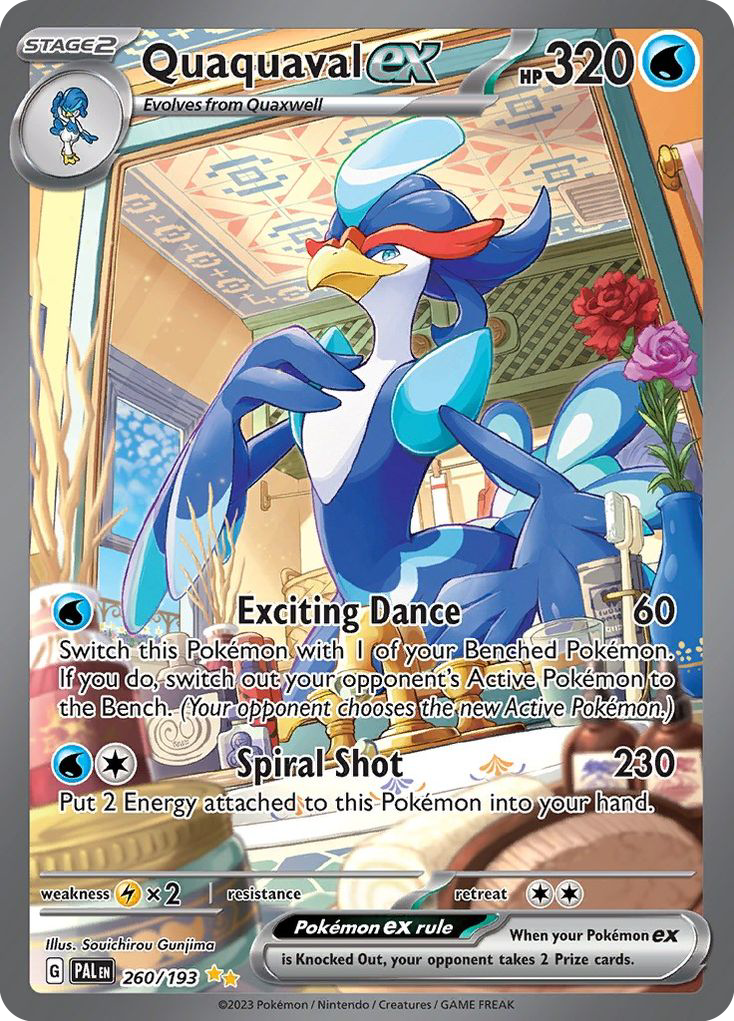
Quaquaval ex, Paldea Evolved 260/193. The payoff, and a Special Illustration Rare. The Pokemon now fills the frame in a dance pose, wings spread, roses in a vase at the right edge, and the same ceiling and lamp still visible behind its head. Three cards, one room, one growing up.
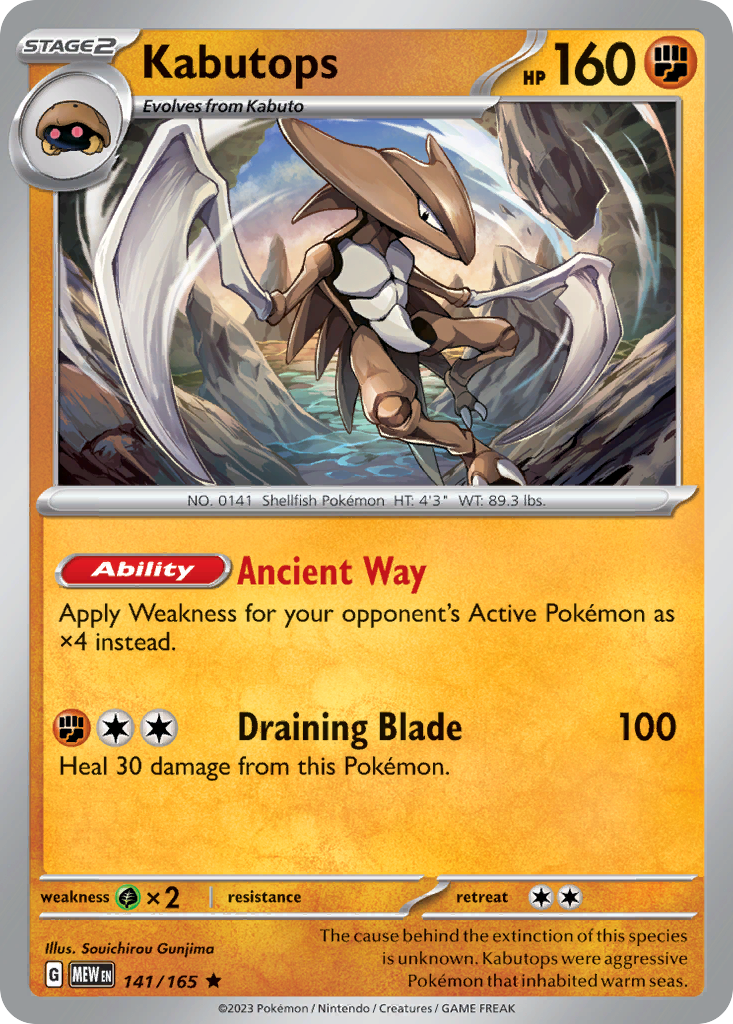
Kabutops, 151 141/165. The dream card. A Kabutops mid slash in a shallow rock pool, scythes carving two white arcs through the frame, stone walls closing in on both sides. He waited for this one, and it shows in how much motion he packed into a plain rare slot.
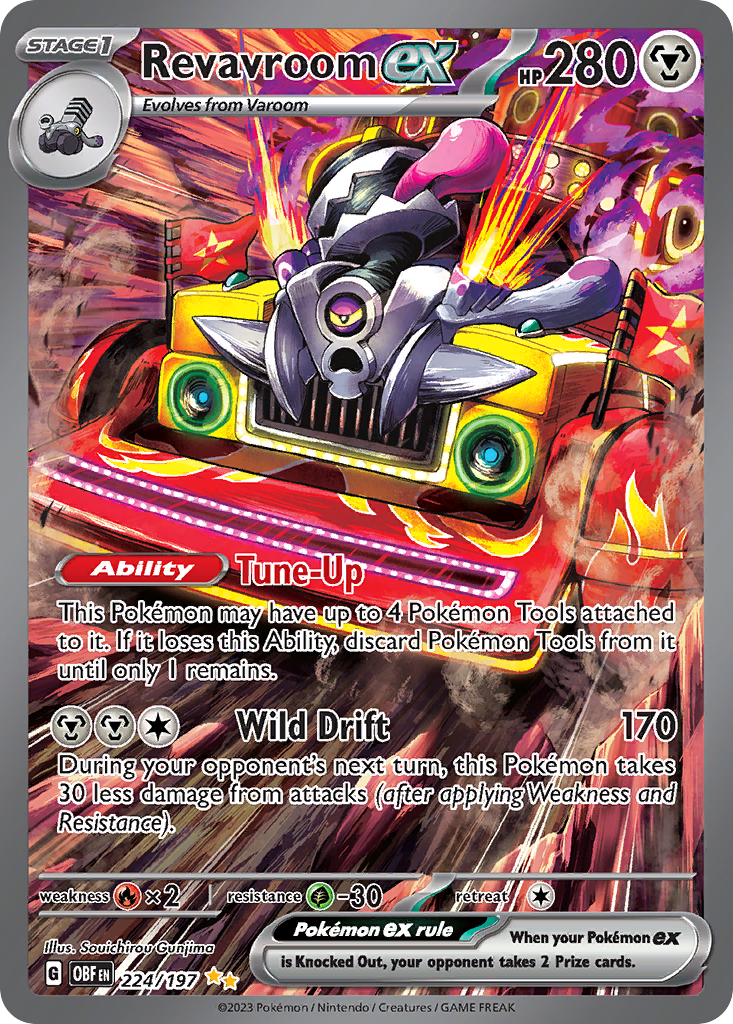
Revavroom ex, Obsidian Flames 224/197. Proof of range. A yellow hot rod coming straight at you with chrome exhausts throwing sparks, purple smoke, red flags and flames licking the bottom of the card. It is the loudest thing in his catalog by a wide margin.
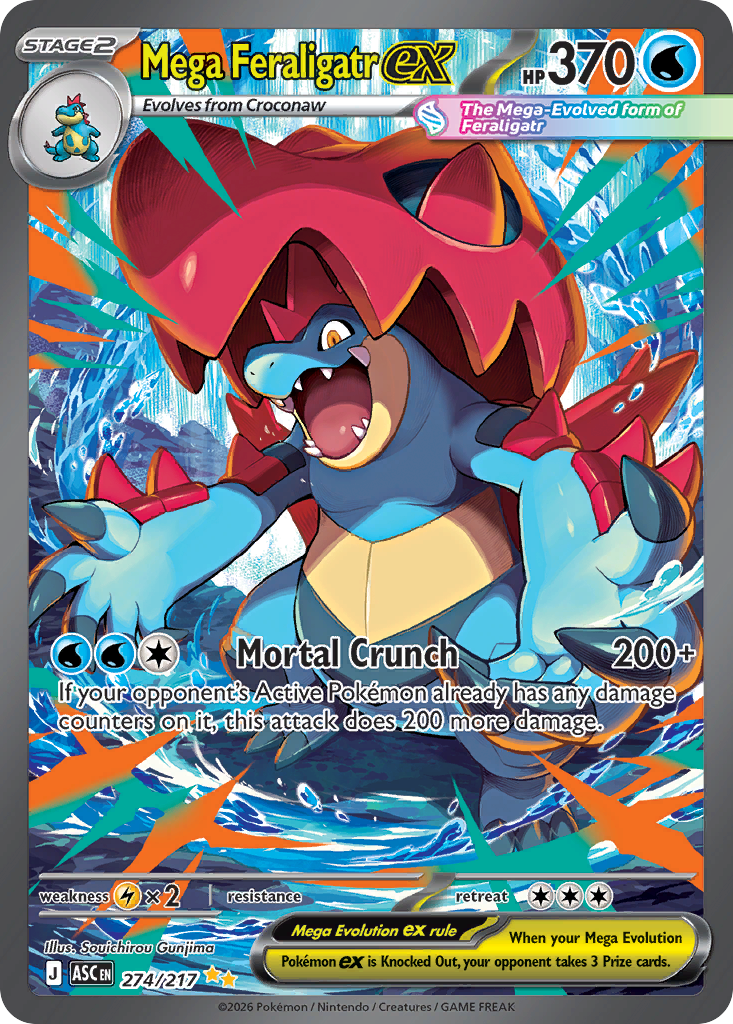
The cover card above is Mega Feraligatr ex, Ascended Heroes 274/217, his most recent showpiece. Jaws open, red crest thrown back, standing in cold blue water while orange and teal shards fly outward. Put it beside the Quaxly and you have the two halves of him on one page.
Build a Souichirou Gunjima binder page
An artist page usually works because the artist repeats a look. A Gunjima page works for a rarer reason: he repeats a place. The three Paldea Evolved Quaxly cards belong side by side in reading order, left to right, because they were drawn to be read that way. Very few illustrators hand you a built in sequence like that.
Start with those three in the top row and treat them as your anchor. Then let the page split. Put his quiet domestic cards down the cool side, where the creams and mint greens blend into each other, and bank his action cards on the warm side where the orange and pink can fight without dragging the whole spread with them. Sorting by temperature rather than by set number is the move here, and our guide to organizing a Pokemon binder covers that approach along with the basics of artist grouping.
It is also an affordable page. Of the six cards above only two carry the Special Illustration Rare tag, and a lot of his best environmental work sits in commons and uncommons that nobody chases. If you want a companion feature on the shelf, the Sanosuke Sakuma artist page pairs unusually well, since both illustrators care more about the room than the pose. For a louder neighbor, the Mega Dragonite ex Special Illustration Rare breakdown sits beside his Mega Feraligatr ex nicely.
Gunjima is early in his run, which is the best time to learn an illustrator. His catalog is small enough to actually finish, his best cards are mostly cheap, and he has already produced the rarest thing in card art: a set of illustrations that only make full sense when you put them next to each other. Build the row and the joke lands.