Goldeen has been in the Pokemon TCG since Jungle in 1999 and until this summer it had never once been given a whole card of artwork. Twenty English printings across 27 years, every one a Common except a Misty's Goldeen from Gym Heroes. Then Pitch Black arrived on July 17, 2026 and handed number 87 to an illustrator called Gemi, who used the space to paint a goldfish pond from inside the water. It is the quietest great card in a set built around the dark.
The art
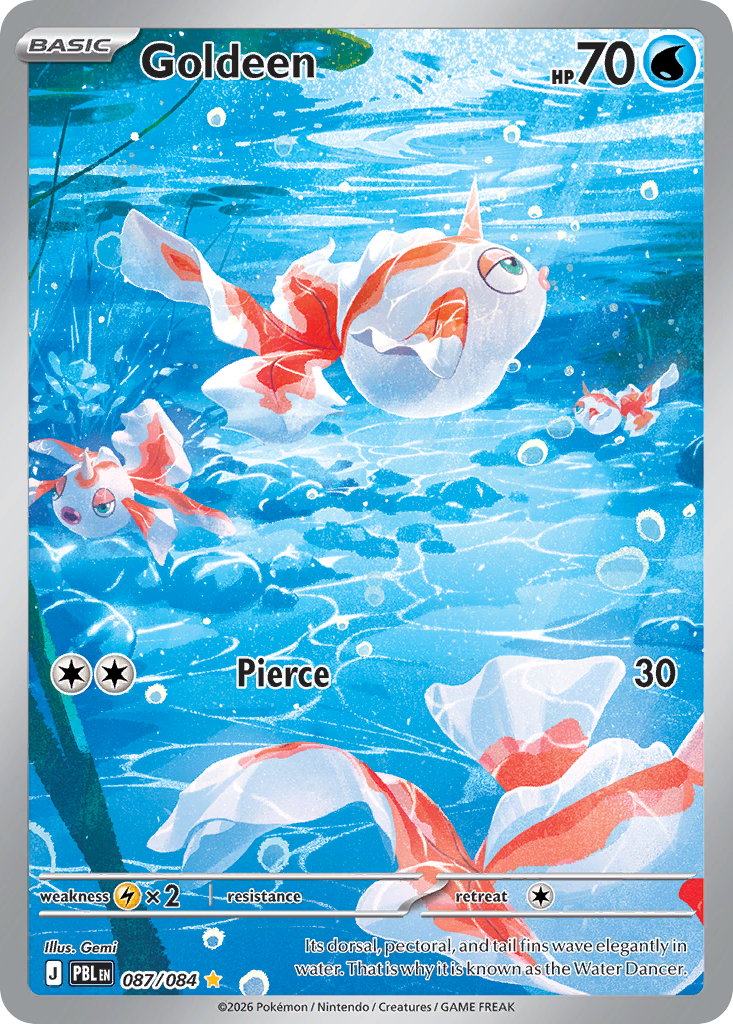
An illustration rare, or IR, is the tier below a special illustration rare. The art fills the card, but the normal attack layout stays printed on top of it and the print run is far larger, which is why the best IRs are the cheapest genuinely good art in modern Pokemon. Pitch Black has eleven, numbers 85 through 95. Goldeen is 087/084.
The scene is shallow water seen from just beneath the surface. The top quarter of the card is that surface, drawn as a mesh of white ripple lines and concentric rings where something has broken through, and the light coming down lands on a pale dappled bed at the bottom. There is no horizon and no sky. You are in the pond.
Gemi puts four Goldeen in the frame at four different distances. The one that reads first is center right and enormous, turned three quarters toward you with its mouth just open, one eye rimmed in pink around a teal green iris. The body is almost white, closer to a show goldfish than the flat orange of the games, and the red sits in soft irregular patches like ink dropped on wet paper. The fins are the whole point. They are painted as translucent fabric, white shading to a warm red at the trailing edge, and they spread far wider than the animal inside them.
Below and to the left, a second Goldeen faces you head on with its mouth in a small circle. Off to the right a third sits tiny and half dissolved in the blue haze. Then the fourth crosses the entire bottom of the card so close to the viewer that only its tail and pectoral fins fit, one red and white sweep spanning the full width beneath the attack line.
That fourth fish is the compositional trick. Gemi left the band of water where the attack text has to sit as nearly empty ripple, so Pierce and its 30 damage land on the calmest part of the painting while every busy detail lives above and below the line.
The palette finishes the job. This card is roughly ninety percent blue, cyan up near the light and a colder cerulean at the bottom, ripple lines in white, one dark stand of pond weed down the left edge. The only warm color anywhere in it is the red on four sets of fins. In a set named Pitch Black, Gemi turned in the brightest card in the box. The card is also a literal reading of its own flavor text, which says the dorsal, pectoral and tail fins wave elegantly in water, and that this is why Goldeen is known as the Water Dancer.
Gemi has 21 English cards and only three are illustration rares: Poliwhirl in 151, Swanna in White Flare, and now this. The best known card in the catalog is probably the Glaceon VSTAR from the Crown Zenith Galarian Gallery. The detail worth keeping is that Gemi also drew Seaking in Twilight Masquerade in 2024, so one illustrator now owns both halves of the line.
Why it is trending
Pitch Black launched on July 17 and the first fortnight of art talk went where it always goes, to the top of the set. Akira Egawa's Mega Darkrai ex is the chase and earns it, and the Morpeko ex special illustration rare was the surprise that outran two of the set's own Mega ex.
What has happened since is that the set guides written after the dust settled keep landing on the same card, and it is not a chase. WoahPoke's Pitch Black roundup picks Goldeen as "the sleeper of the set" and calls it underrated outright. NinePocket's set guide describes it as the quiet standout. Nobody coordinated that. It is what happens when a card is simply better than its rarity tier.
The calendar is the other half of it. 30th Celebration lands worldwide on September 16, the first Pokemon TCG set to release everywhere on the same day, and the whole thing is built on looking backward: 30 classic cards returning with an anniversary stamp, 30 different Pikachu each drawn by a different illustrator, and a new Futuristic Rare tier illustrated by YOSHIROTTEN. So an entire community is currently walking back through 30 years of cards asking which Pokemon ever actually got something. Goldeen is a strange answer to that question. It has been printed for 27 of those 30 years and it got its first real canvas six weeks ago.
Be honest about the ceiling. This is an illustration rare of a 70 HP Basic whose attack does 30 damage. It prints in volume, it does nothing in a deck, and there is no scarcity story here. That is the appeal rather than the problem. You can own the best water card in the set without ever treating it as an asset.
Build a binder page around it
Blue is the easiest color block to fill and the hardest to make interesting, because most blue cards are blue in the same way. Goldeen is not. It is blue that is nearly white, with the values sitting high and bright, so it will punch a hole in an ordinary water page. Use that instead of fighting it. Run color sort in the builder, pull your blues into one spread, then order them by lightness rather than by hue and put Goldeen at the top of the gradient. A page that fades from near white through cyan into deep navy reads as designed rather than dumped.
The better page is thematic. Build a waterline page: nine cards whose illustrations sit at or under the surface, with Goldeen in the center pocket because it has the most depth in it. Pitch Black starts that page for you, since Primarina at 88 is the set's other Water illustration rare. The Magikarp illustration rare belongs there too, for exactly the same reason as Goldeen: an unloved Water Pokemon handed to an artist who took it seriously.
There is a line page hiding here as well. Gemi drew Seaking in Twilight Masquerade in 2024 and Goldeen in Pitch Black in 2026, so a two card evolution feature by a single illustrator costs almost nothing and tells a small story. Give those two the middle of a nine pocket page and fill the ring around them with older Goldeen prints: Kagemaru Himeno's original from Jungle, Yuka Morii's clay sculpted Goldeen from Neo Revelation, the two Atsuko Nishida ones from Deoxys and Diamond and Pearl. That is 27 years of one goldfish in nine pockets, and every card on the page is bulk except the one in the middle.
The guide to organizing a Pokemon binder covers how to plan a feature page before you start buying for it, which matters more here than usual, because a history page only works if you fix the order first.
The lesson repeats every set, and Goldeen is about as clean a case of it as you will get. A set decides what matters, prints it at the top rarity and puts it on the box, and then some Common that has sat in bulk boxes since 1999 gets handed to an artist who actually cares, and that becomes the card you keep opening the binder to look at. Buy the one with the fins.