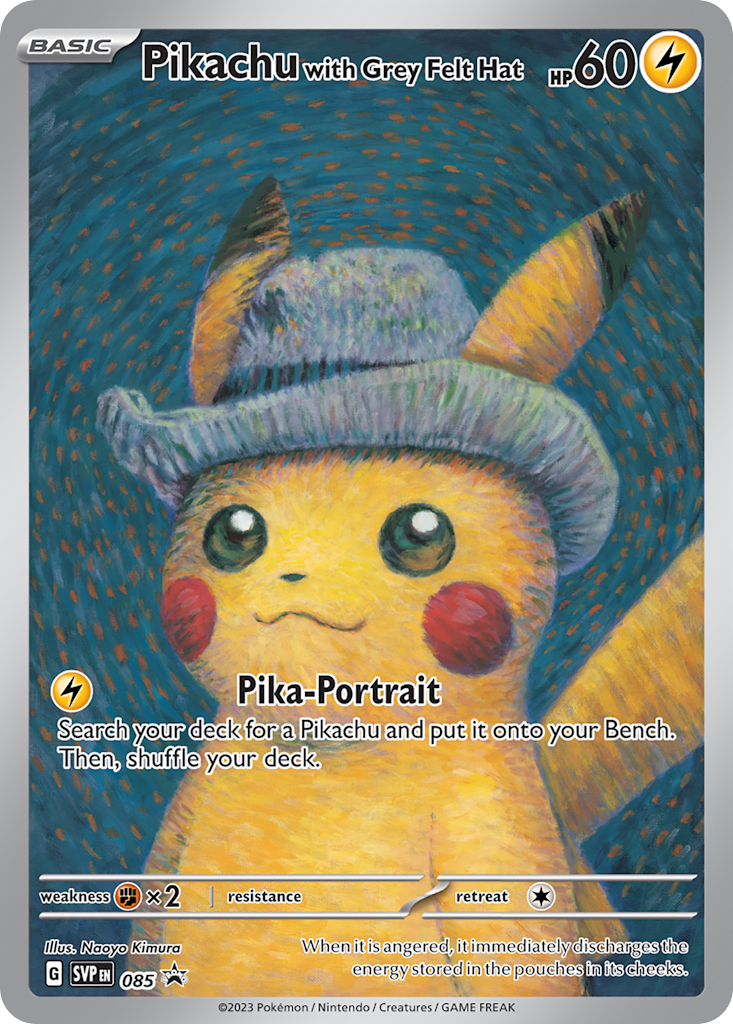
In 2023 the most talked about Pokemon card on the planet was a Pikachu in a grey felt hat, painted in thick swirling brushstrokes and handed out at a museum in Amsterdam. Almost everyone who chased that card could tell you it was a Van Gogh tribute. Almost nobody could tell you who painted it. The answer is Naoyo Kimura, a pokemon card artist who had been quietly working on the game for twenty five years before that card made her briefly famous, and whose back catalog is one of the loveliest in the hobby.
Who is Naoyo Kimura
According to Bulbapedia's illustrator profile, Kimura was born in 1960 and has worked on Pokemon TCG illustrations since 1998. That puts her in the earliest generation of card illustrators, the small group who were drawing this game before anyone knew whether it would last.
Her debut cards were Seel, Zapdos and Graveler from the Japanese Expansion Sheet Series 2. English speaking collectors met her a little later, when Bulbapedia records her first English releases as the Wizards Black Star Promos Articuno, Zapdos and Moltres, distributed alongside the film The Power of One. Bulbapedia counts 276 cards to her name including reprints, and the Pokemon TCG API returns more than 250 under an artist search, which is a genuinely enormous body of work for one illustrator.
Card art was never her only outlet. Bulbapedia notes she illustrated several volumes of the Pokemon Tales picture book series, including Come Out, Squirtle, Fly On, Butterfree and Dragonite's Christmas. That children's book background is the key to reading her cards, and it shows up in every one of them.
Then came the card that changed her public profile. For the Pokemon x Van Gogh Museum collaboration, staged to celebrate the museum's 50th anniversary, Kimura contributed illustrations of Pikachu and the Honchkrow and Corviknight lines, inspired by Van Gogh's Self-Portrait with Grey Felt Hat and Wheatfield with Crows respectively. Bulbapedia's page for the resulting promo records that the primary campaign ran at the Van Gogh Museum from September 28, 2023 to January 7, 2024, with visitors completing a guided Pokemon Adventure activity through the galleries and trading the finished leaflet for the card. It could also be earned as a bonus with any Pokemon Center x Van Gogh Museum purchase. Because it never saw worldwide distribution, the card was banned from the 2024 Pokemon World Championships.
Her signature style
Kimura paints places, not portraits. Where a lot of illustrators frame a creature front and center against a wash of color, she builds a full location around it and lets the Pokemon live there. There is nearly always real architecture or real terrain in the frame: mossy stone walls, temple steps, wind bent grass, a rock shelf above deep water. You get the sense you could walk around behind the subject and the world would keep going.
The second tell is her light. She loves the edges of the day, that band of sunset orange behind a dark treeline, or a full moon washing a wall in cool blue. Her palettes are muted and naturalistic rather than candy bright, built from greens, slate greys, dusk purples and warm amber, and she is unusually good at painting the moment where warm and cool light meet.
The third is restraint. Her Pokemon are rarely mid battle. They stand, they watch, they peek over a wall. Storybook illustrators learn to tell you everything about a character with one calm pose, and Kimura never lost the habit. If you flip through a binder and stop on a card that feels like a page from a picture book, where the setting is doing as much work as the creature and the light looks like a specific time of day, check the credit line. There is a good chance it reads Illus. Naoyo Kimura.
Cards to know
Her catalog spans from the Neo era to the current sets, so the range on display here covers about twenty five years of the same steady hand.
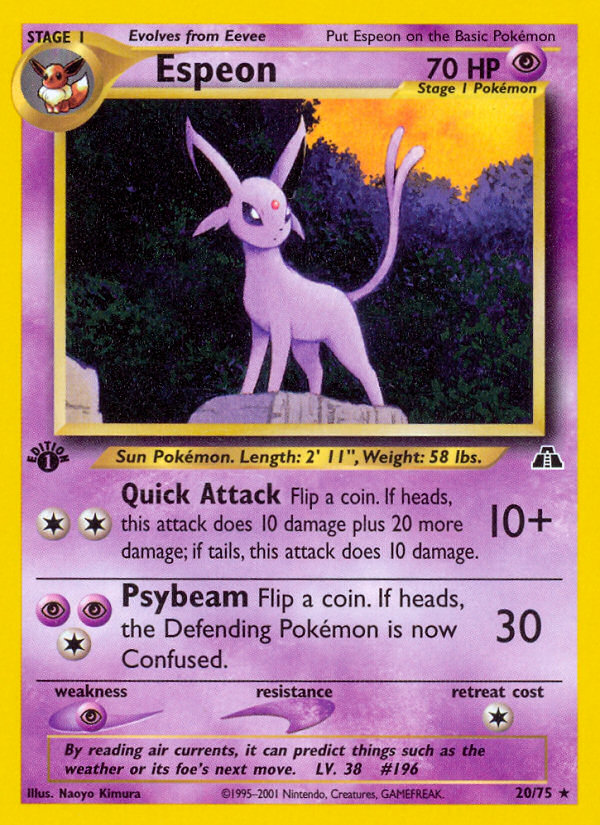
Espeon, Neo Discovery. Espeon on a rock ledge at dusk, forked tail raised, backlit by a burning orange sky over a black treeline. It is a masterclass in silhouette, and it explains why so many collectors who cannot name Kimura can picture this exact card.
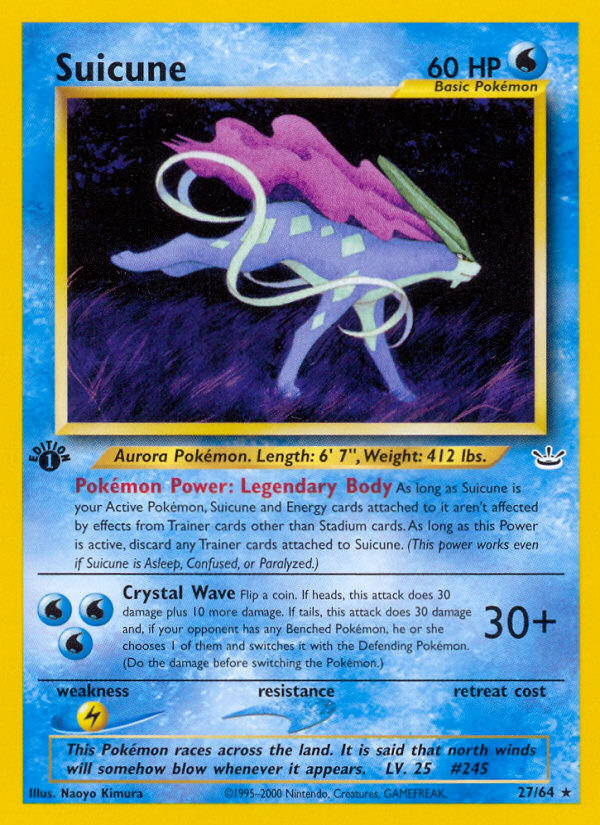
Suicune, Neo Revelation. The legendary beast running low across a dark plain with its crystal mane streaming behind it. The whole card is built from purples and mauves with the grass whipping past underneath, and it captures speed without a single motion line.
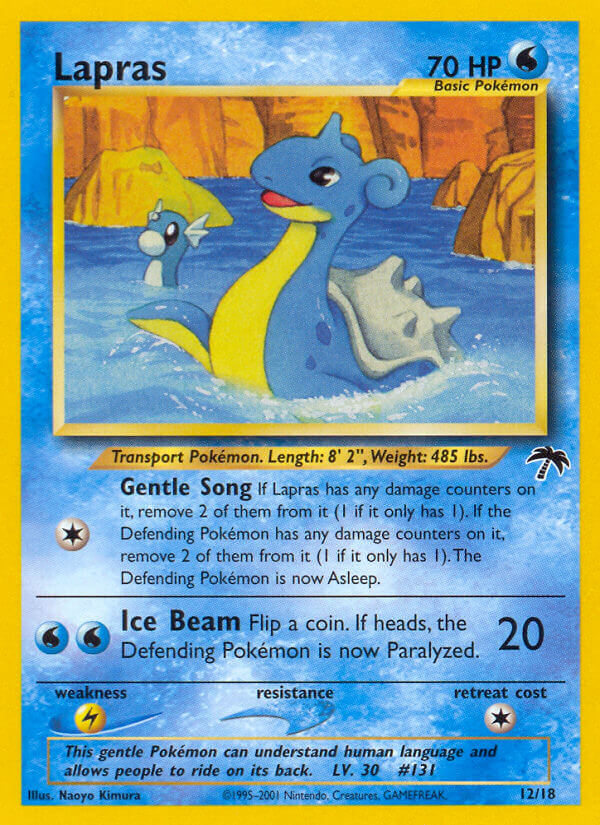
Lapras, Southern Islands. Lapras surfacing in bright shallow water below orange cliffs with a Dratini peeking out behind it. This one matters for a structural reason covered below, because it is a piece of something larger.
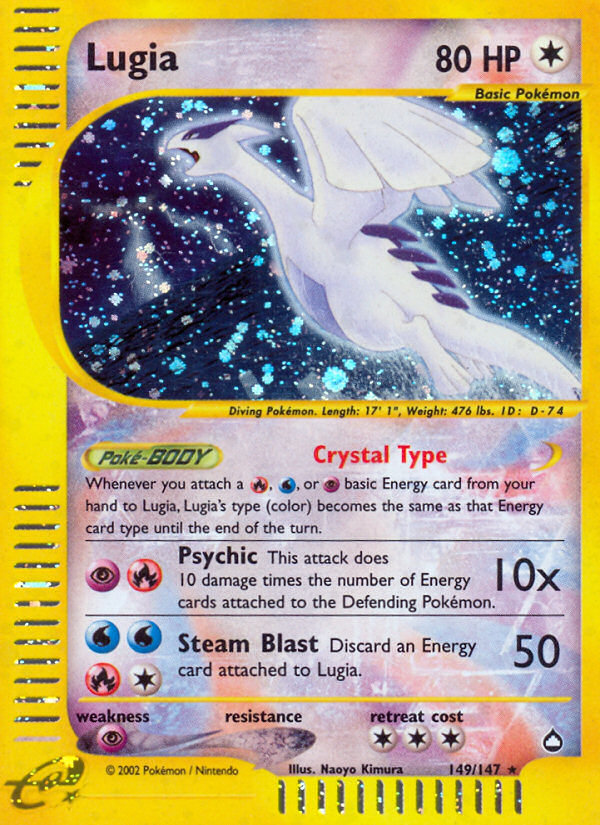
Lugia, Aquapolis. A Crystal Type secret rare numbered 149 out of 147, with Lugia gliding through a starfield of holo sparkle. Kimura rarely goes this cosmic, and the contrast with her grounded work makes it feel like an event.
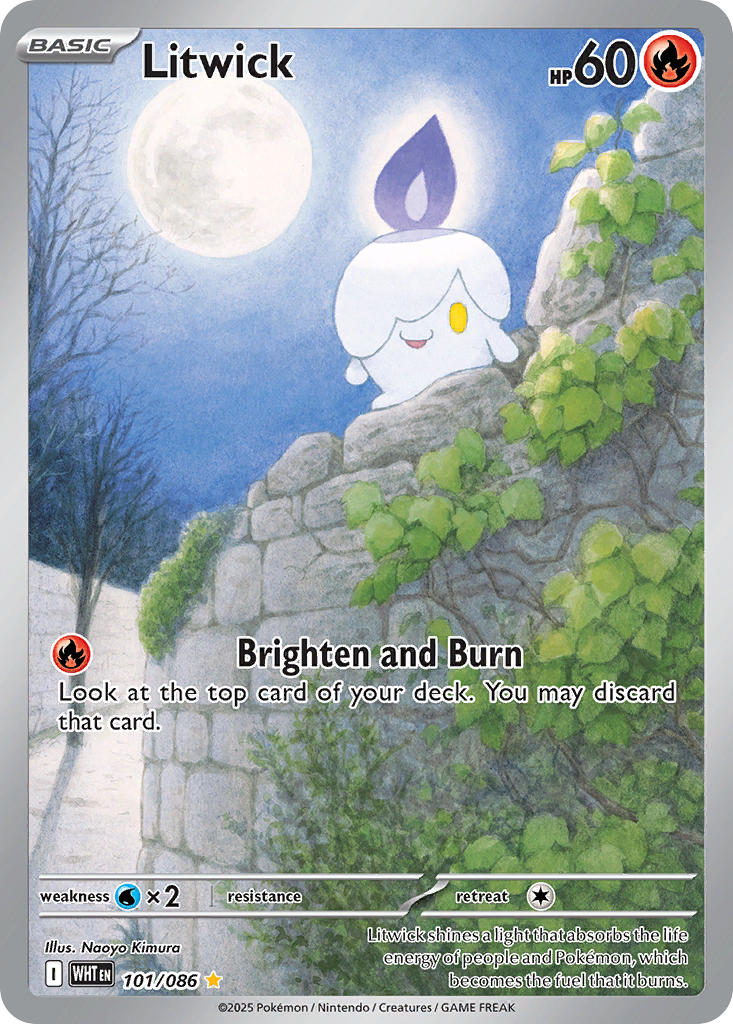
Litwick, White Flare. Proof she is still at the very top of her game. This 2025 Illustration Rare puts a tiny Litwick peeking over an ivy covered stone wall under a full moon, its flame the only warm light on the card. Every Kimura signature is here at once.
Build a Naoyo Kimura binder page
Kimura hands you the single best artist page concept in the hobby, and most collectors walk right past it. Bulbapedia's entry on the Southern Islands set explains that its 18 cards form two complete pictures of nine cards each, the Tropical Island set illustrated by Naoyo Kimura and the Rainbow Island set by Keiko Fukuyama. Nine cards, one artist, one picture, and a standard binder page holds exactly nine cards. Her half of Southern Islands was practically designed for a three by three sleeve.
That is the anchor page. Build it first, then build a second page around her mood. Because her palettes are so consistent, a Kimura page sorts beautifully by light rather than by type: put the sunset cards together on one row, the moonlit and night cards on another, the daylight water scenes on a third. You end up with a page that reads as one continuous painting even though the cards come from twenty years apart. If you like the idea of cards that join into a bigger image, the same instinct drives the Clefairy illustration rare that is only half a painting.
The budget news is good too. Most of her work sits on commons, uncommons and old non holo rares, so a stunning page costs very little. Drop the Aquapolis Lugia or a Neo holo in the center as your anchor and let the quiet cards surround it. Our guide to organizing a Pokemon binder covers artist grouping and color sorting if you want the layout fundamentals before you buy anything, and you can lay the whole thing out in Binder Builders first to see how the light sorted rows land.
Naoyo Kimura is the answer to a question a lot of collectors ask without realizing it: who made the old cards feel like somewhere you could go? She has been building those places since 1998, one quiet common at a time, and the Van Gogh Pikachu only pointed a spotlight at work that was already extraordinary. Learn the light and the stonework, and you will start spotting her name everywhere. For another artist whose fingerprints are older than most collections, read our Atsuko Nishida artist feature.